There are phrases that remain longer than entire lectures. They are often quite banal and worn out. Often it is the circumstances, or the person, or the state of soul, or the inner question that makes them sound resonant precisely at that moment. For me, such were the morning spiritual reflections of Fr. Luke Mata, Vicar of Opus Dei in California: a happy priest is a priest who prays first of all.
No excessive activity can replace prayer. We cannot rely too much on our own strength.
And there was a certain irony in this — because the week was full: topics, discussions, U.S. corporate law, canon law, media, administration, psychology, leadership, fundraising. But precisely in that rhythm it became obvious: if prayer is not the center, everything else quickly becomes noise and fatigue.
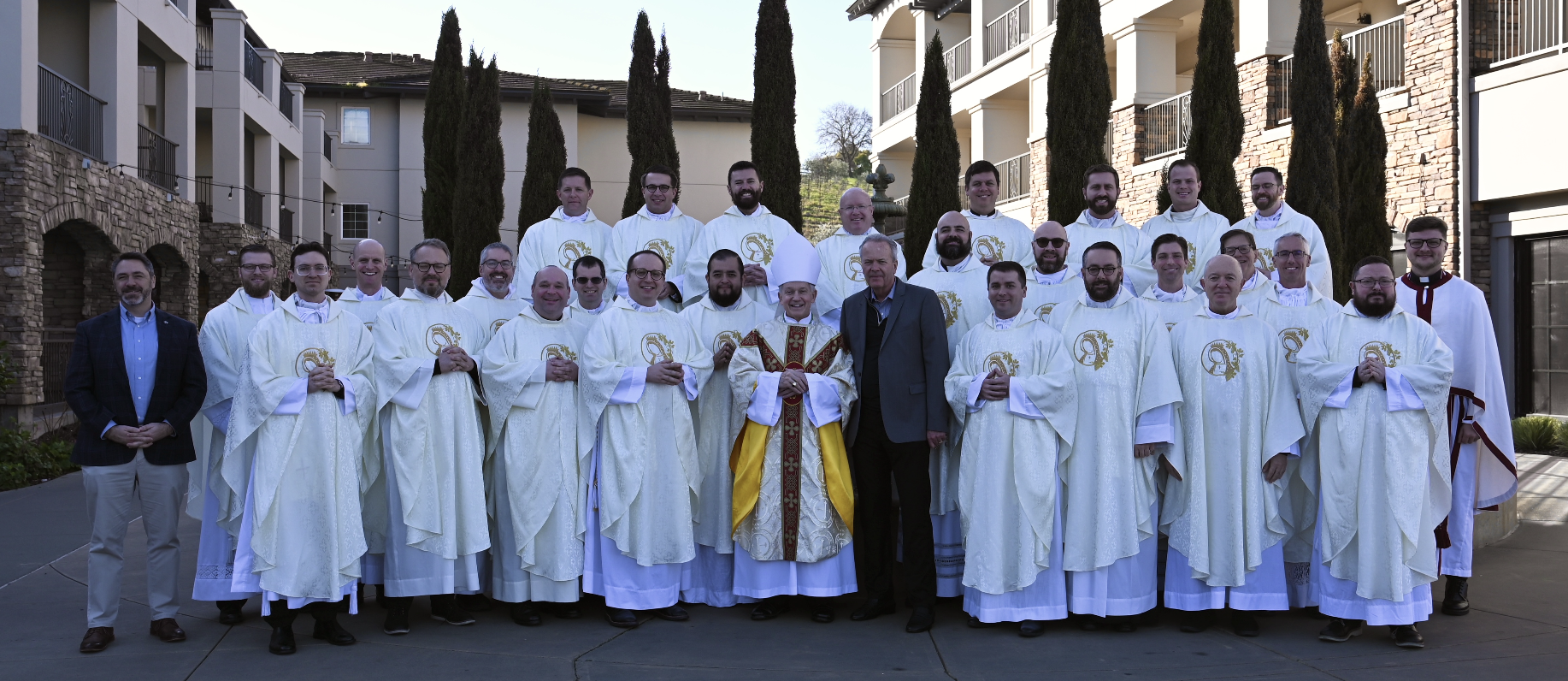
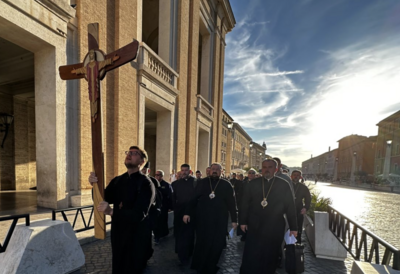
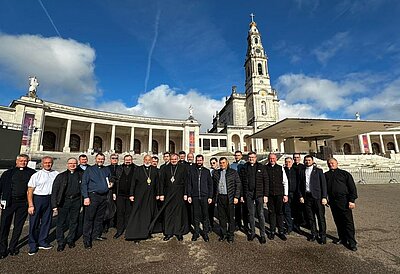
This year at the Shepherd’s Circle Study Week there were 26 priests from different cities in the United States. I was the only priest of the Eastern Catholic Church; the rest were Roman Catholics. A community mostly of young priests — sincere in their desire to serve God as best as possible. One could see devotion in prayer, love for the beauty of the liturgy, seriousness in their attitude toward the priesthood.
Common prayer became the heart of everything. Every day — in the morning, at noon, in the evening — the Liturgy of the Hours, Holy Mass, the silence of adoration. It was a powerful experience: when priests who came from very different circumstances and parishes become simply brothers before God.
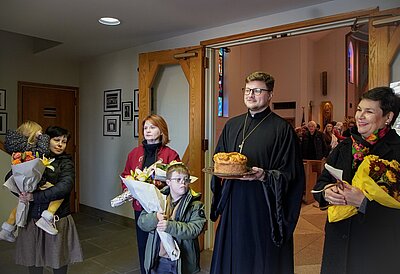
For me, this week had yet another dimension — the perspective of a married priest and father. The direct experience of fatherhood removes the need for many metaphors. When you live in a family, when you hear a child’s cry, see your wife’s fatigue, the joy and tension of ordinary family life, then the word “father” becomes very concrete. The possibility of maintaining an intimate and personal connection with each family in the parish is a true value, which is felt especially vividly against the background of the experience of large Roman Catholic parishes.
This week also became for me a moment of examination and confirmation: how much what I do corresponds to the universal values of the Church, despite ritual differences. The scales of parishes are different, traditions are different, the liturgical language is different. But the foundations — prayer, dedication, the fatherly stance of the pastor — remain unchanged.
I learned to appreciate even more the tradition in which I grew up and serve. This does not mean that it is better or worse than others. It is simply different. It has its own richness — and, like every tradition, its limitations and weaknesses. But precisely in diversity the Church breathes more fully.
The program was truly strong. We listened about accompanying priests in the sphere of mental health, about mentorship and practical assistance (Jack Beers). We spoke about the digital space as a new missionary field — not for self-promotion, but for the salvation of souls (Grady Connolly). There was a deep and very sober introduction to the rights and duties of a pastor, where canon law appeared not as bureaucracy, but as a form of love and justice (Michael J. Mazza). We also heard about the “spirituality of compliance” — how conscientious administration and legality are part of the holiness of a priest (John C. Peiffer II). There was also what is uncomfortable for many: fundraising is also a ministry, because the invitation to generosity is an invitation to discipleship (Timothy R. Busch). And all of this was rooted in the main thing: the priest as shepherd, not manager, a man of sacrifice, not only of organization (Bp. Thomas John Paprocki).
I am grateful to the Napa Institute and Shepherd’s Circle for this space of prayer, brotherhood, and sober formation. In a world where a priest can easily dissolve into activism, this week quietly but clearly reminded me again: begin with prayer. And return to it. Again and again.
And perhaps precisely there — is the source of priestly joy.
Fr. Ruslan Borovyi