- Fundraisers 2026
- Archeparchy
- Our faith
- Offices and ministries
- News and Updates
- Events
- Parishes
- Child Protection
- Ways to Give
- Subscribe to "The Way"
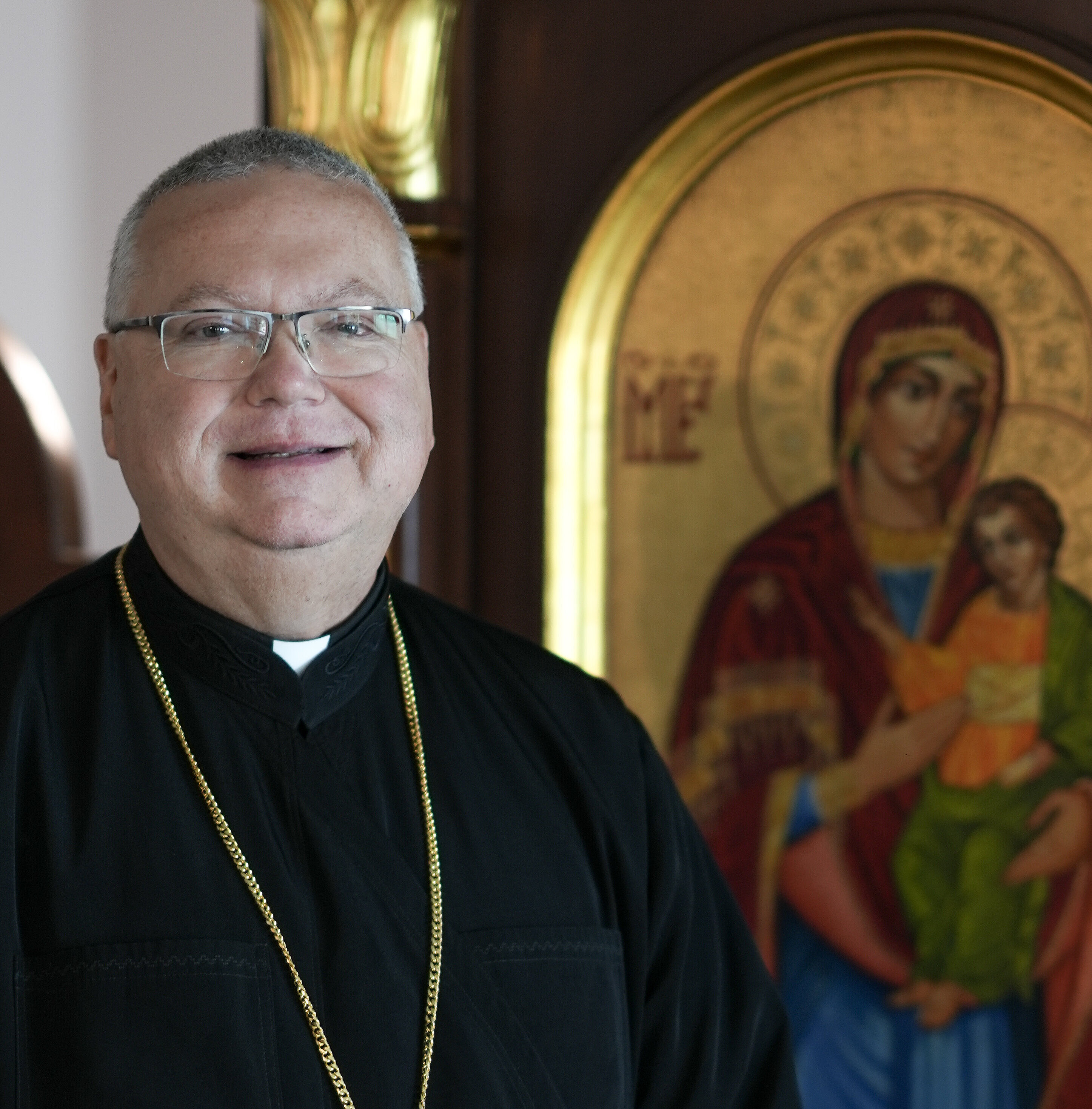
The central theme of the 2026 Synod of Bishops of the Ukrainian Greek Catholic Church is “The Pastoral Care of Vocations to the Priesthood and Religious Life.” Continuing our series on priestly and religious vocations, we invite you to meet the Very Reverend Archpriest Robert J. Hitchens, who has served the Archeparchy of Philadelphia as a priest for 32 years. He likes to be called Fr. Robert. His vocation did not begin with one dramatic moment. It grew quietly through the life of his family and parish: Sunday Liturgies, serving at the altar, the encouragement of his pastor, the faith passed on by his mother and grandmothers, and even a small statue of the Sacred Heart of Jesus that he carried to bed as a child.
For a time, however, Fr. Robert imagined a very different future. While studying at Temple University and working at Chestnut Hill Hospital, he considered becoming an emergency room physician. Gradually, he began to sense that he might be called not to be a “physician of bodies, but a physician of souls.” Decades later, that calling continues to shape the way he understands priesthood: as bringing Christ to people in the most tender moments of their lives, from Baptism and marriage to illness and the final journey from this life. Today, while facing a serious health challenge, he speaks with striking simplicity about the prayer, Eucharist, and support of others that give him strength to continue serving - and to do so with joy.
You have been a priest for 32 years. Looking back, when did you first begin to sense a call to the priesthood, and how did that call take shape over time?
I have been a priest for 32 years, serving the Archeparchy of Philadelphia in uninterrupted priestly service. Truthfully, I count the beginning of this journey from January 1988, when I arrived at St. Josaphat Seminary as a college seminarian. But my vocational journey began much earlier, from the time I was a child. One of the best days of my life was the first time I was able to serve at the Divine Liturgy as an altar boy. In those days, you could not become an altar boy until after you had made your First Holy Communion. So, on May 18 1975, I made my First Holy Communion at Saints Peter and Paul Church in Bridgeport, Pennsylvania, where my pastor was Monsignor Ronald Popivchak.
One of the important things about my vocation story is that I came from a family that was very supportive. We were not a rigidly spiritual family, but always full of faith and we went to church. At nine o’clock on Sunday morning, we would attend the Old Slavonic Liturgy, followed by Sunday school. After Sunday school, we would go over to my grandmother’s house, where my grandfather always made sure there were rolls, ham, and cheese. My brothers, cousins, and I would all gather there and eat together. In those days, as I like to say, the seed of the idea of priesthood was always being planted. Father Ron would often ask us, “Who would like to be here one day at the altar, celebrating as a priest?”
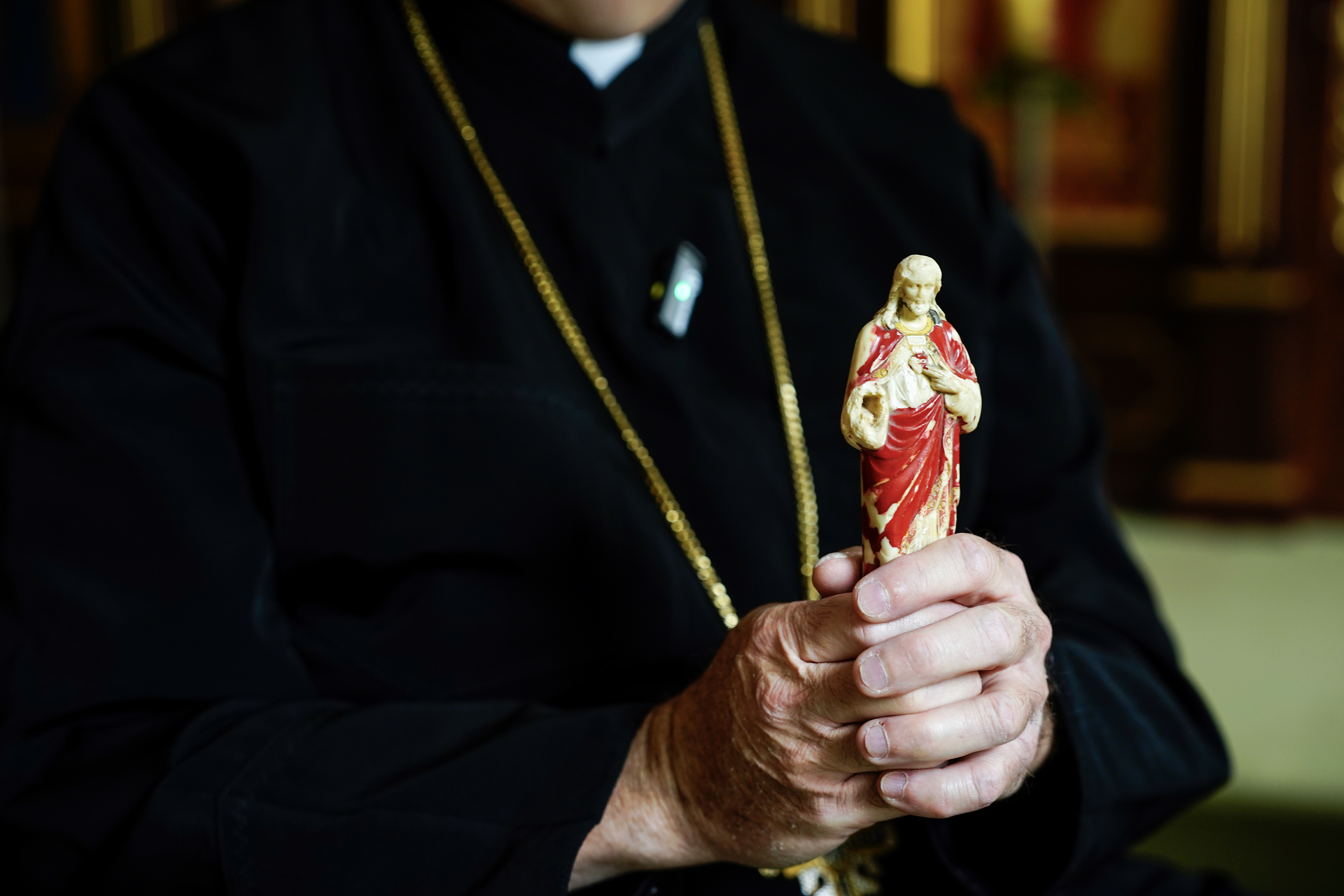
My grandmothers were very instrumental in instilling that sense of vocation, as was my mother. Most children, when they go to bed at night, take a teddy bear to sleep with them. My mom gave me this little plastic statue of the Sacred Heart of Jesus. She had received it from her grandmother when she was probably 12 or 14 years old, and then Mom gave it to me. I used to literally take it to bed with me at night. Little seeds from the very beginning - support, affirmation, having faith, the idea of maybe being a priest someday—were very important in my family.
Little things like this make a big difference. Even just teaching a little boy how to make the sign of the cross nicely, taking seriously what we do when we go to church, and serving at the altar - all of that is so important.
You mentioned that the idea of priesthood had been with you since childhood. But at one point, you were seriously considering another path—you wanted to become a doctor. How did you eventually realize that your calling was to the priesthood?
My parents were always open to the idea. My father would say, “If you think maybe you want to be a priest, good. It’s your choice, your decision.” But along the way, I was still trying to figure out whether or not this was for me. I also developed other interests. Among them was the thought that I would rather be a doctor, especially an emergency room physician—not a trauma surgeon, but an emergency room physician. I suppose that came partly from the multiple trips to the emergency room, whether it was me attempting to be Evel Knievel, crashing my bicycle and breaking my shoulder and collarbone, or my brothers perpetually needing stitches in the head, breaking an elbow, or having a broken leg. I always found it fascinating.
Then I started college at Temple University in Philadelphia. I had the opportunity to work at Chestnut Hill Hospital in the laboratory and, believe it or not, to draw blood from people—both inpatients and people in the emergency room. And I began to see that there was something else that was nagging me. It was the idea that maybe the calling was not to be a physician of bodies, but a physician of souls.
By then, I was already about halfway through my undergraduate studies at Temple, with the idea of hopefully going to medical school or doing something else. Chemistry was always a challenge, giving me a real hard problem, so I was also starting to think, “This premed program might not be for me.” But then I thought, it’s now or never to take a chance. The idea of serving at the altar, of being a priest, of following in Father Ron’s footsteps, had always been there. So finally, I worked up enough courage to talk to him about it.
What happened after you first spoke about your vocation? Who helped you understand that priesthood could truly be your path?
After I finally worked up enough courage to talk to Father Ron, the next thing I knew, in August 1987, I had an appointment with Father John Fields, who was doing vocation work at the Chancery in Philadelphia. I went down to the old Cathedral Rectory, and we sat, met, and talked. I remember him very fondly. He asked me, “Have you ever thought about what it’s really like to be a priest?” What he meant was that, in those days, we were going to be celibate priests. There really wasn’t an option to be a married priest here in the Archeparchy of Philadelphia. He said, “Think about this, because sometimes guys don’t think about it, and I want to be honest with you. It’s Christmas Eve. You celebrate the Christmas Liturgy, people come to church, and then they go home with their families. And where do you go? You go back to your rectory. They’re going home, opening presents and celebrating, and you’re probably going home to bed because you have to be up early for the next set of Liturgies on Christmas Day.” He told me, “I like to be honest with people, so that you think about this and have a full picture of what you might be getting yourself into.” And that still didn’t discourage me. To this day, I appreciate the honesty and straightforwardness of Father John Fields.
As soon as I was finished speaking with him, the next thing I knew, I was being taken to the third floor of the Chancery, and there I was sitting in Archbishop Stephen Sulyk’s office. No one calls me Bobby, but Archbishop Stephen always called me Bobby, even to the last time we saw each other, before the Covid 19 pandemic. He said to me, “So you think you might want to be a priest?” And I said, “I’d like to try.”
What did seminary formation - and the people who accompanied you along the way - teach you about what it really means to be a priest?
I started seminary in January 1988, and along the way, it wasn’t easy. And it’s not supposed to be easy, because being a priest is not something for the weak. It’s for the strong. There are things you need to learn about yourself, and things you need to learn about others, in order to be able to help others. And that takes time. When we talk about nurturing vocations, it really comes down to a culture of vocation. That nurturing comes from the parish community, from family, from friends, from bishops, and from mentoring priests. I had a lot of good mentoring priests along the way, and they shared with me aspects of what it means to bring Jesus Christ to people.
One of my professors at The Catholic University of America told us something that I still remember to this day, 32 years after being ordained: “The family calls at 2:30 in the morning - and it’s always at 2:30 in the morning - and they want you to come, you go.” You go because they want somebody to come and pray with them, because either grandma or grandpa or mom or dad - or, God forbid, a child or another family member - needs the priest to come and bring Jesus to them.
So, my vocation journey has always been about learning to represent Jesus - not as Jesus, but as a servant of Jesus to the people - and to bring the life-giving sacraments, the Holy Mysteries, whether through confession, the anointing of the sick, or bringing the Holy Eucharist to someone who is ill or nearing the end of life. There is a moment during the ordination of a priest in our Church that captures this for me. After the consecration, the Archbishop places the Body of Christ in the hands of the newly ordained priest and reminds him that one day he will have to render an account of what he did with his life in serving the Holy Eucharist. It is sacred, holy, serious, but also joyful.
What do you think is the greatest challenge today for a young man who feels called to the priesthood?
I think the greatest challenge today for a young man being called to the priesthood is that there is so much that you can do with your life today. We have become a global Church and a global society, and there is so much out there. But there is a happy life in being a priest, and a lot of those other interests can be incorporated into priesthood today. Somebody can be a welder, electrician, hvac technician and be a priest, or study psychology and be a priest, study literature and be a priest, study astrophysics and be a priest, or be a military chaplain in addition to parish work.
And who knows - if we really do put a colony on the moon in the future, a chaplain to the moon. Think big. And I think it is important for young people to see that church is a happy place. It’s not a place where people come and sit there thinking, “Oh God, why do I have to be here? Why are you dragging me here, Mom?” We can have fun, get together, and learn together. There are all kinds of opportunities and ways for men to serve.
Vocation is not only a moment, but a lifelong response. How do you continue to say “yes” to God’s call today, especially when it is hard?
One has to have a strong prayer base, and I mean centered in Jesus Christ, whether it’s through longer prayer or just remembering to say, “God, help me help this person in the moment.” And always remembering that it’s not me. It’s Jesus helping me, and Jesus giving me the grace to be able to help the people. So it’s always Christ-centered.
It’s also remembering that, especially for a priest, strength comes through celebrating the Divine Liturgy. It’s no secret - I’ve been very open with people since January about my situation, dealing with esophageal cancer and the treatments I’m undergoing. Every time I partake of the chalice and the Precious Blood, I ask the Lord for the grace to be able to carry on through this illness, and that the Precious Blood of Jesus Christ rid me of this physical ailment and give me the spiritual grace to be able to continue to serve the people. When I’m in Philadelphia, I make a special trip down to St. Peter’s Church on Girard Avenue to visit St. John Neumann. We’re two “Philadelphia priests”, and I ask him to pray for me. The Redemptorist Fathers there tell me, “Ask him to pray with you, Father.” I know that I literally have people praying for me, and Liturgies and Masses being celebrated for me all over the world. And that’s what has given me the strength to carry through this and to serve through all of this. I haven’t missed a service, and, thank goodness, I’ve been blessed to receive the grace to be able to do that - and to be joyful.
After so many years of priestly ministry, what gives you the greatest joy in being a priest?
The most joy in my priesthood comes especially when I receive the awesome privilege to baptize new babies. But also, so very importantly, when I am able to visit with somebody who needs some extra prayers and grace as they are getting ready to take their last breath on earth. I pray that, for them, it will be an easy transition from this earthly life to eternal life. And when it is really close to the end, I always tell people, “When Jesus comes, you grab His hand and go with Him. He is going to take you with Him, to be with Him forever.” Especially with people I have known in these communities for a while, it is important for them to know that it is okay to go, and that Jesus has them and will take care of them. I believe that, and I tell them that they should believe it too.
That is really what gives me the joy of being able to be a priest and to be with the people in the most tender and most significant times of their life.
Helping to marry a young couple, hearing the confession of somebody who has not been to confession in years, and sometimes being able to say, “Welcome back. Jesus loves you, and we love you. Let’s keep up the good work, and let’s walk together.”
Interview by Halyna Vasylytsia