- Strategic Resources
- Archeparchy
- Our faith
- Offices and ministries
- News and Updates
- Events
- Parishes
- Youth Protection
- Subscribe to "The Way"
In the tradition of our Church, May is a special time dedicated to the Blessed Virgin Mary. For generations, the Ukrainian people have nurtured a deep love for and trust in Mary, turning to her in prayer as a Heavenly Mother and Protectress. This is why pilgrimage sites, miraculous icons, and the traditional May devotions — known as Molebens or May Services — hold such an important place in Ukrainian spiritual life. During these services, the faithful gather at churches, chapels, and grottoes to honor the Mother of God through prayer and song.
Ukrainians brought this devotion to Mary with them to America. The Ukrainian Catholic Archeparchy of Philadelphia is home to several special Marian sites: Assumption of the Blessed Virgin Mary Ukrainian Catholic Church in Centralia, PA, a home to the Icon of Our Lady of Pochaiv; Christ the King Ukrainian Catholic Church in Philadelphia, PA, which houses a copy of the miraculous Zarvanytsia Icon of the Mother of God; Sts. Cyril and Methodius Ukrainian Catholic Church in Olyphant, PA, home to the Icon of Our Lady of Zhyrovychi; as well as the monastery of the Sisters of the Order of Saint Basil the Great in Jenkintown, PA, where a grotto with the Pochaiv Icon of the Mother of God is located. Throughout May we will share stories about these pilgrimage sites, their history, and their spiritual significance. We warmly invite you to share your memories, photos, and stories connected to these holy places to feature in our upcoming publications.
IT ALL BEGAN WITH A DREAM
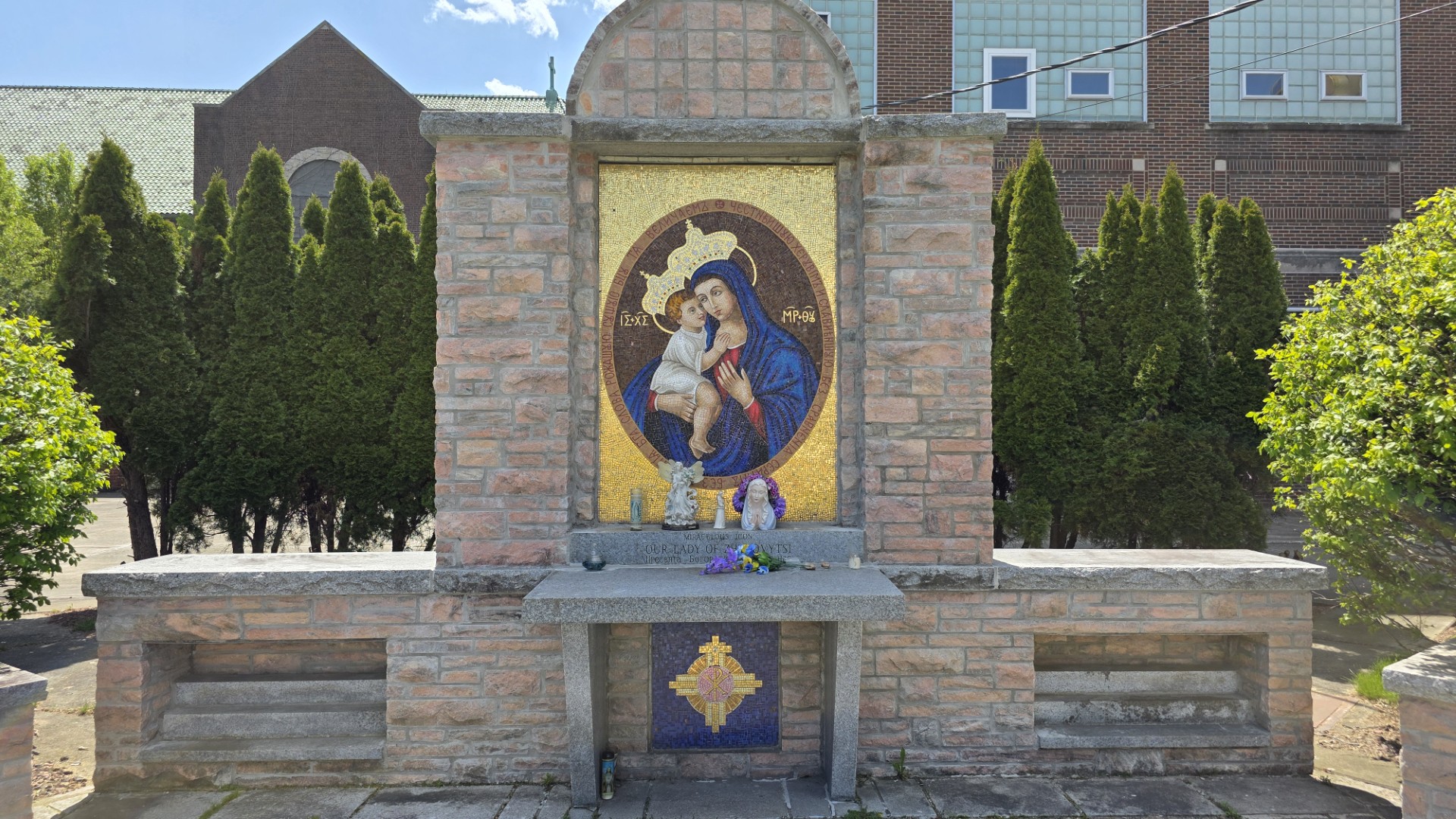
Long before candles flickered before the Icon of Our Lady of Zhyrovytsi in Olyphant, and pilgrims gathered there in prayer, the shrine existed only as a quiet dream in the heart of one parish priest. In 1926, Father Michael Gyuransky, pastor of St. Cyril and Methodius Ukrainian Catholic Church, began planning a Marian shrine in front of the parish rectory. He envisioned a peaceful place where people could come to pray. Sadly, however, he died suddenly in 1935 before the dream could be realized. Years passed. Pastors changed, generations grew up, and the unfinished dream slowly faded from memory. Then, in 1952, two parishioners approached Monsignor Stephen Hrynuck, the new pastor of St. Cyril and Methodius Church, reminding him of Father Gyuransky’s unfinished vision and asking him to fulfill what parishioners had already begun calling “the dream of the shrine.”
Monsignor Hrynuck embraced the idea, especially because the parish had endured painful internal divisions and tensions during that period. He believed the community needed healing, later describing the project as an effort to “invoke peace and unity in the parish after a recent period of discord among parish groups.”
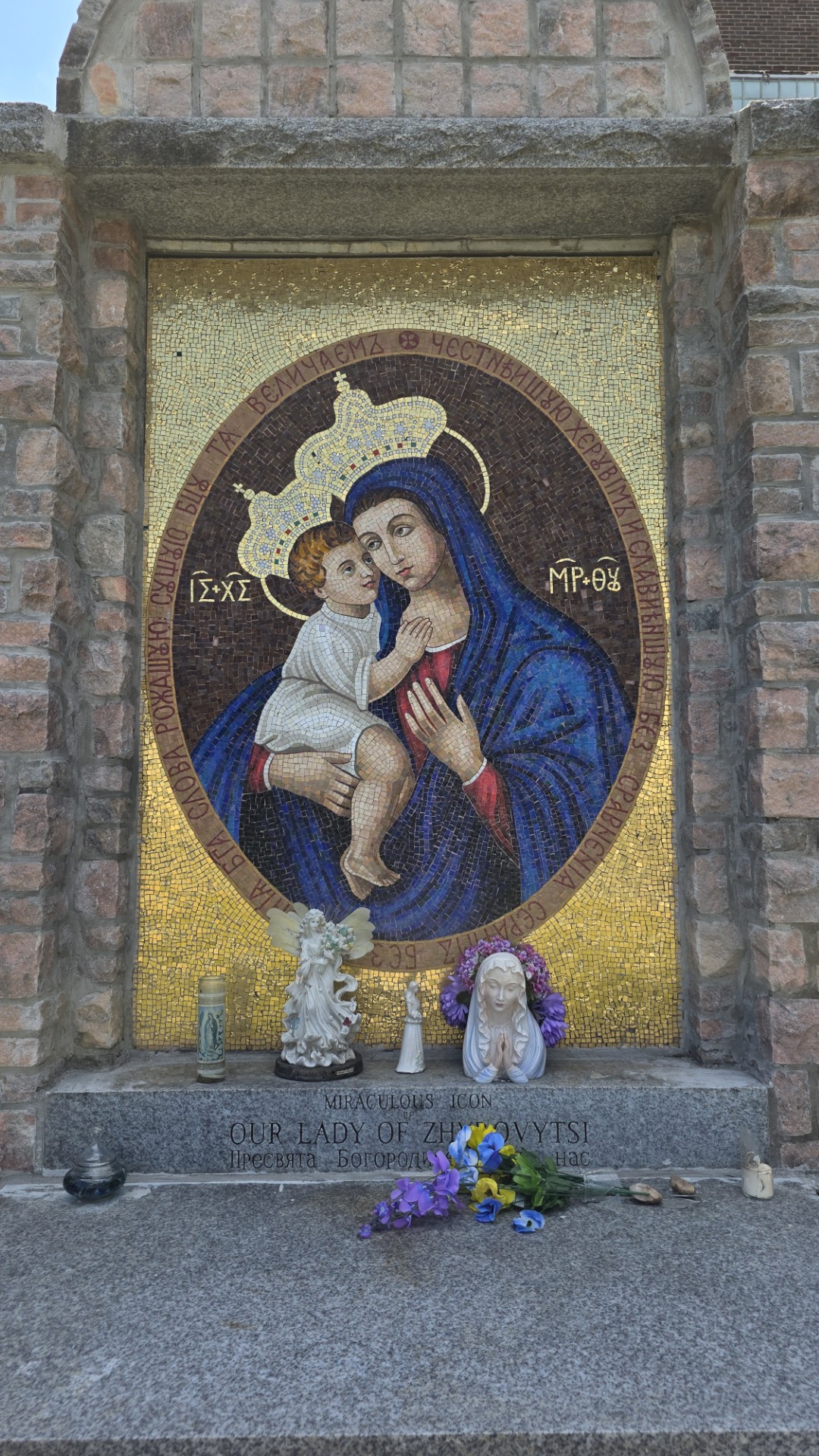
One day, while visiting the home of the Milia family, Monsignor Hrynuck noticed an image of Our Lady of Zhyrovytsi hanging on the wall. Something about the icon immediately drew his attention, and he asked where it had come from. The answer deeply moved him: the icon had once belonged to Father Michael Gyuransky himself, who had cherished the dream of building the shrine. Monsignor Hrynuck later wrote that it seemed as though Almighty God had been guiding them toward “the right choice,” even without their realizing it.
In 1979, more than half a century after Father Gyuransky first envisioned the shrine, construction finally began. Monsignor Hrynuck later recalled feeling as though “the Blessed Mother smiled upon our shrine project.” A dream that had once seemed buried with the man who first imagined it was finally becoming reality.
The shrine was built from Georgian marble, while the central mosaic image of Our Lady of Zhyrovytsi was crafted in Italy. A place for votive candles was placed beneath the icon, and the shrine itself was surrounded by granite walkways, flower beds, and fountains. At night, floodlights illuminated the image of the Mother of God, while the deep blue mosaic background surrounding the icon resembled a night sky illuminated by prayer.
THE HISTORY OF THE ICON
The original miraculous Icon of Our Lady of Zhyrovytsi dates back to the fifteenth century and is closely connected to the monastery in Zhyrovytsi, located in present-day Belarus, a region historically connected to the spiritual tradition of the Kyivan Church. According to tradition, the icon was discovered by shepherd children near a pear tree after a mysterious light appeared in the forest. Over time, Our Lady of Zhyrovytsi became especially associated in popular devotion with ordinary people, families, children, and all those searching for hope in difficult times.
For Ukrainian immigrants far from their homeland, Marian devotions like this often became something greater than religious tradition alone. They carried memory, identity, language, prayer, and a sense of spiritual continuity with the Church and villages people had left behind in Eastern Europe. And so, the icon that once quietly hung on the wall of a single parish family home gradually became the spiritual heart of an entire pilgrimage tradition in northeastern Pennsylvania.
A PLACE OF PILGRIMAGE
In 1983, St. Cyril and Methodius Church officially established the annual pilgrimage to the Shrine of Our Lady of Zhyrovytsi. Each year, pilgrims gathered outdoors for Divine Liturgies, Molebens, processions, confessions, prayers for healing, and anointing with holy oil. Candles burned before the icon, while Marian hymns echoed across the parish grounds late into the evening.
For many people, the pilgrimage became far more than an annual religious event. It became a place where people brought burdens too heavy to carry alone. Some came praying for healing after illness. Others arrived carrying the pain of losing loved ones. Parents prayed for their children. Families prayed for reconciliation. Immigrants prayed for relatives far from home. Many simply came searching for peace during difficult seasons of life.
Over the years, the pilgrimage developed its own rhythm and memory within the life of the parish.
STORIES PEOPLE STILL REMEMBER
As the years passed, stories of answered prayers and unexpected graces became part of the shrine’s spiritual memory. Among the most remembered is the story of Michael Metrinko, a parishioner of St. Cyril’s Church who became one of the American hostages during the Iranian hostage crisis of 1979–1981. Month after month passed, and the fate of the hostages remained uncertain. During that time, parishioners continually gathered in prayer at the shrine. Eternal vigil candles burned day and night in Olyphant and neighboring Scranton as the community prayed for Michael’s safe return home. Then, after 444 days in captivity, the hostages were finally released. When Michael Metrinko returned home, he personally came to the shrine and extinguished the vigil candles that had burned throughout his imprisonment. For many parishioners, that moment became forever connected with the intercession of the Mother of God.
Another story tells of Paul Polcha, who gradually lost his eyesight after a workplace accident. After many months of prayer at the shrine, his vision unexpectedly began to return. Still another story speaks of a father and son separated for forty-seven years who were reunited shortly after prayers offered during the annual pilgrimage.
WHY PEOPLE STILL COME
Decades after the shrine was first built, people still quietly make their way along the small pathway leading to the image of the Mother of God in Olyphant. The world has changed. Generations have changed. The children and grandchildren of immigrants now speak different languages, live in different cities, and face different struggles than those who first built the shrine. And yet people continue to come.
Some arrive carrying illness. Others carry grief too deep for words. Some come exhausted by fear, loneliness, family wounds, or uncertainty about the future. Perhaps that is why Marian shrines continue to speak so deeply to the human heart — not because suffering suddenly disappears there, and not because life instantly becomes easier, but because such places remind people that they are not abandoned in their pain.
Prepared by Halyna Vasylytsia