Anna: Values and Choice
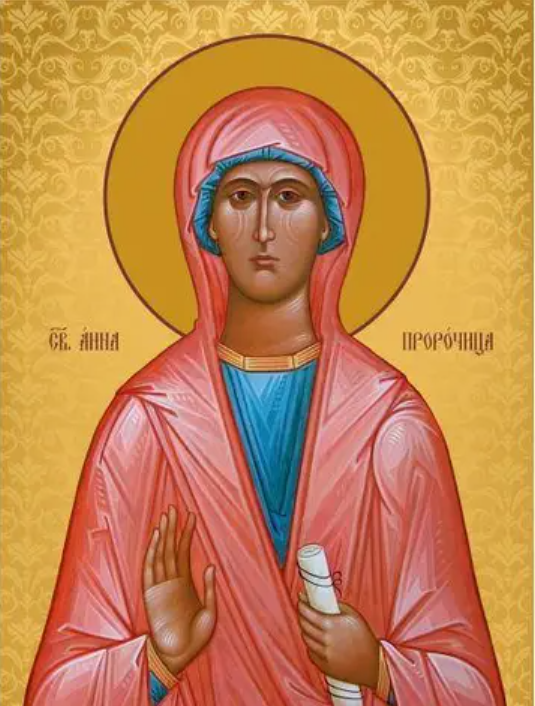
We continue our project on women’s ministry in the Church. Today, let us reflect on the prophetess Anna — a woman living in a patriarchal society where she was not legally equal to men, could not serve as a formal witness in court, and was not permitted to teach the Torah publicly. Her social status would have been defined through her father, husband, or sons; she was a widow, advanced in age, and had no one — how much more vulnerable could a person be?
Yet she becomes a prophetess, one of the very few women who holds spiritual authority, and the first to proclaim the Messiah after His birth. What makes her who she is?
What is a value for you?
To better understand Anna, let us reflect on the concept of “value.” What does it mean to me? Is it about what I want to have, or about who I want to be? Is it about my expectations of life, or about what life expects of us? Is it my vision of the circumstances I want for my life, or my vision of the person I want to be regardless of circumstances?
Anna vs. the Culture of Self-Realization
We live in a culture of self-realization, where people are constantly asked: Who are you? What makes you different? What have you achieved? A person’s value is often measured by visible results — career, influence, number of followers, completed projects. To be noticed, one must be successful.
Anna lives according to a radically different logic. She does not ask herself how to realize herself or how to obtain certain “rights” within a society that marginalizes her. She lives according to her value — faithfulness to God. And in the end, without possessing the “authority” to teach the Torah like the scribes and Pharisees, she bears witness to its fulfillment. The Evangelist Luke calls her προφῆτις — a prophetess — granting her spiritual authority.
Anna and the Danger of Spiritual Narcissism
In spiritual and religious life, there are also temptations — for example, turning God into part of one’s personal project. At times, prayer, fasting, and ministry can quietly become instruments of self-affirmation, a way to feel “deeper,” “more chosen,” or “more enlightened” than others. This is known as spiritual narcissism. Saint Ambrose writes about the prophetess: “Anna does not seek human praise; she gives birth to faith, not to glory” (Expositio Evangelii secundum Lucam).
Her heart is an example of freedom from this trap: she does not speak about herself — the prophetess speaks about Him. And in this, one of her core values is revealed: not to be the center of the story, but to recognize the One who is its meaning. This is why she recognizes the Messiah in the Temple when others pass by.
Value as Choice
Value is not always determined by circumstances or external freedom. A person’s true value is revealed in their choice — in the decision to remain faithful to one’s principles, even when everything else is taken away.
Edith Eger, in her book The Choice, writes that in a concentration camp everything can be taken from a person — home, food, freedom, security — but the one thing that cannot be taken away is their value and the choice that is grounded in values.
Anna experienced something similar. In her time, a woman’s social status was determined by her husband, yet she had neither a husband nor children to rely on the system. She does not change the system, but she also does not allow the system to define who she is. And although circumstances made her vulnerable, no one could take away her ability to remain faithful to God, to await His coming, and to discern His action. This was her deepest value.
…And in Conclusion
Anna does not change the course of history through grand gestures. She does not create programs, leave behind a school of disciples, or found a movement — although none of these would be wrong if they were grounded in genuine values. She lives in truth with herself, and this proves to be enough to place her at the very center of the event of salvation.
Her life reminds us that God does not come where He is spoken about the most, but where He is awaited. Not where a person strives to realize themselves, but where they refuse to substitute meaning.
Halyna Vasylytsia