Exalting the Cross in Our Lives: A Reflection by Fr. John Mikitish

The feast of the Exaltation of the Cross originated in 629 or 630 A.D. When the Persians had besieged and sacked Jerusalem in 614, they made off with the True Cross and other relics. After the Byzantine emperor Heraclius finally forced the Sasanian monarch to sue for peace after 15 years of conflict, the Greeks’ terms included the return of these holy items. The exact details are uncertain; the Cross may have been returned in March of 629 or 630, and September 14 may have been the day that the Holy Sponge, one of the instruments of the Lord’s Passion, was solemnly returned to the city and affixed to the Cross, which was then elevated in triumph at the Holy Sepulcher. 

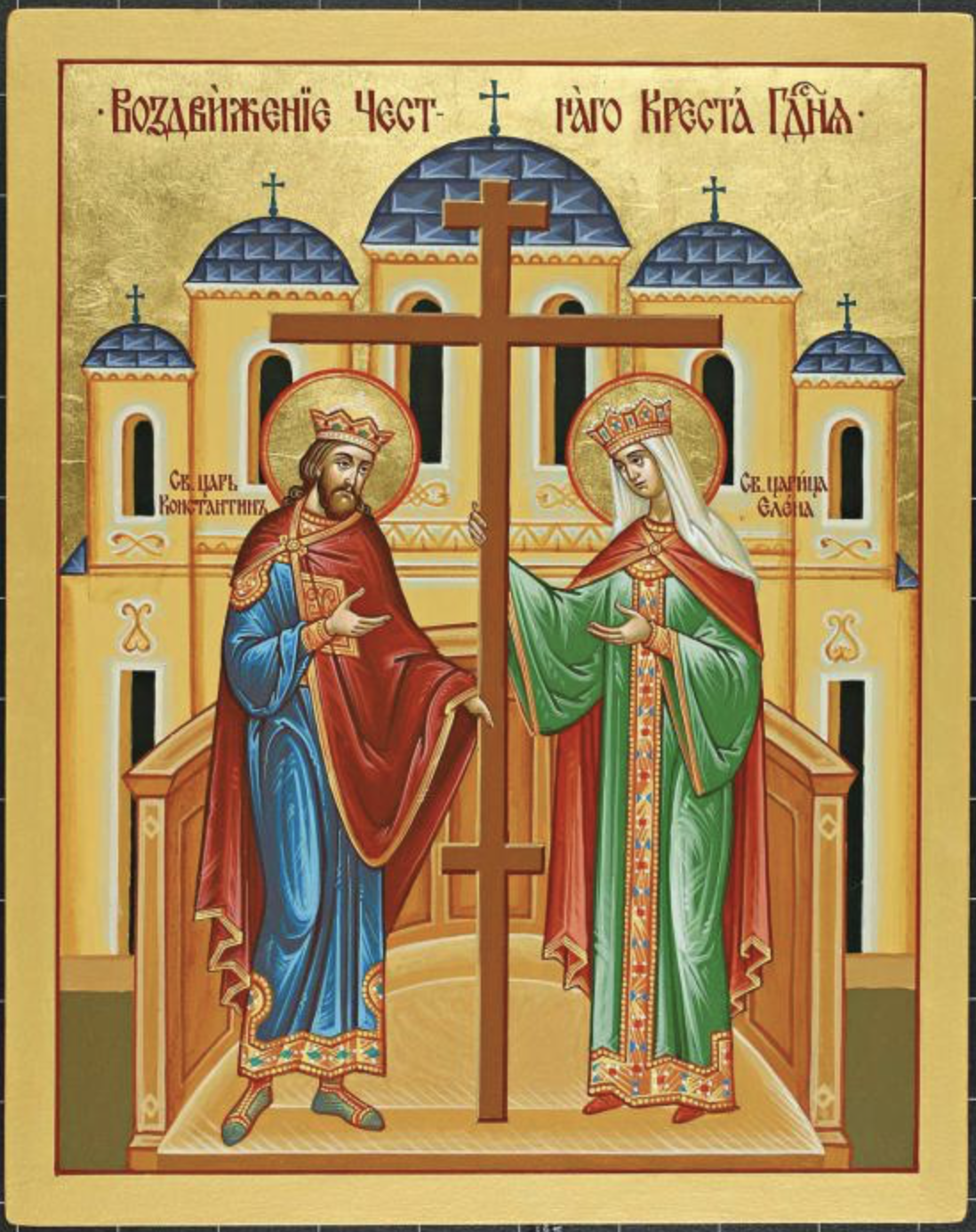
In our Church, this celebration has also become connected to another, earlier historical event, the Finding (or Invention) of the Cross by St. Helen, the mother of St. Constantine. Thus, many icons for the feast show the patriarch of Jerusalem, St. Macarius, lifting up the newly-discovered Cross, with St. Helen in prayer at its foot. 

However, in the hymnography of the feast, we hear precious little about either of these events. Instead, the Cross is presented to us from the perspective of eternity, as a perennial source of joy for the entire universe. At many cathedrals and monastery churches, the celebration of the feast even includes a special rite of the Exaltation, in which the bishop blesses with the cross in each of the four cardinal directions. In other words, the Exaltation is not a remembrance of something past; rather, the Exaltation of the Cross happens again and again. 

The question is then put to us: how shall we exalt the Cross in our lives? How shall we raise it up in our hearts? How shall we lift it up in our speech and actions? The Cross is exalted whenever we are crucified with Christ, dying to ourselves and living for God and neighbor. But what does this look like in practice? 

Perhaps we might begin with crucifying our tongues, our words. As St. James writes in his catholic epistle, “the tongue is a little member and boasts of great things. How great a forest is set ablaze by a small fire! And the tongue is a fire” (Jam. 3: 5–6). The practice of crucifying the tongue necessarily begins with watching over our speech. If we do so, we soon notice how many words we waste, how often we complain, how often we speak ill of our neighbor, gossiping and faultfinding. Becoming aware of this, we can begin the struggle to change it, with the help of God. We should pray together with Psalmist: “Set a guard over my mouth, O Lord, keep watch over the door of my lips!” (Ps. 140/141:3). 

Of course, crucifying our speech is no easy task. St. James even says that no man can tame the tongue, but that should not stop us from trying. Recall the story of Abba Achilles, one of the desert fathers, who held a bitter word back in his mouth until he spit up blood. This is a sign of the difficulty, but also urgent necessity, of the struggle to keep our words pure and godly. 

Related News

More News
Remembering September 11, 2001 Through the Voices of Our Community

#U.S.

#Archeparchy

Remembering September 11, 2001 Through the Voices of Our Community

Metropolitan Ambrose Senyshyn: 50th Anniversary of His repose in the Lord

#U.S.

#Archeparchy

Metropolitan Ambrose Senyshyn: 50th Anniversary of His repose in the Lord

A New School Year Begins at Assumption Catholic School

#U.S.

#Archeparchy

A New School Year Begins at Assumption Catholic School

85th Anniversary of St. Josaphat Seminary

#U.S.

#Archeparchy

85th Anniversary of St. Josaphat Seminary