"If Even One Person's Mind Changes, It's Worth It": Inside Two Trips to Wartime Ukraine

Andrea Kochan Neagle is the Executive Director of Catholic Charities, Diocese of Allentown, the social services arm of the Diocese serving Berks, Carbon, Lehigh, Northampton, and Schuylkill counties. A fourth-generation member of St. John the Baptist Ukrainian Catholic Church in Northampton, PA, she has been deeply active in parish life. Most recently, she joined a delegation from the Ukrainian Catholic Archeparchy of Philadelphia to visit Ukraine witnessing firsthand the pastoral and humanitarian efforts unfolding amid the ongoing war.

You are of Ukrainian descent but had never visited Ukraine before. What led you to make your first trip during the war?

During our parish anniversary celebration in Northampton, I gave remarks about treasuring our faith and the cultural practices woven into it—treasuring them as a gift passed down to us, and as a call to action to keep sharing those gifts with our children and grandchildren.

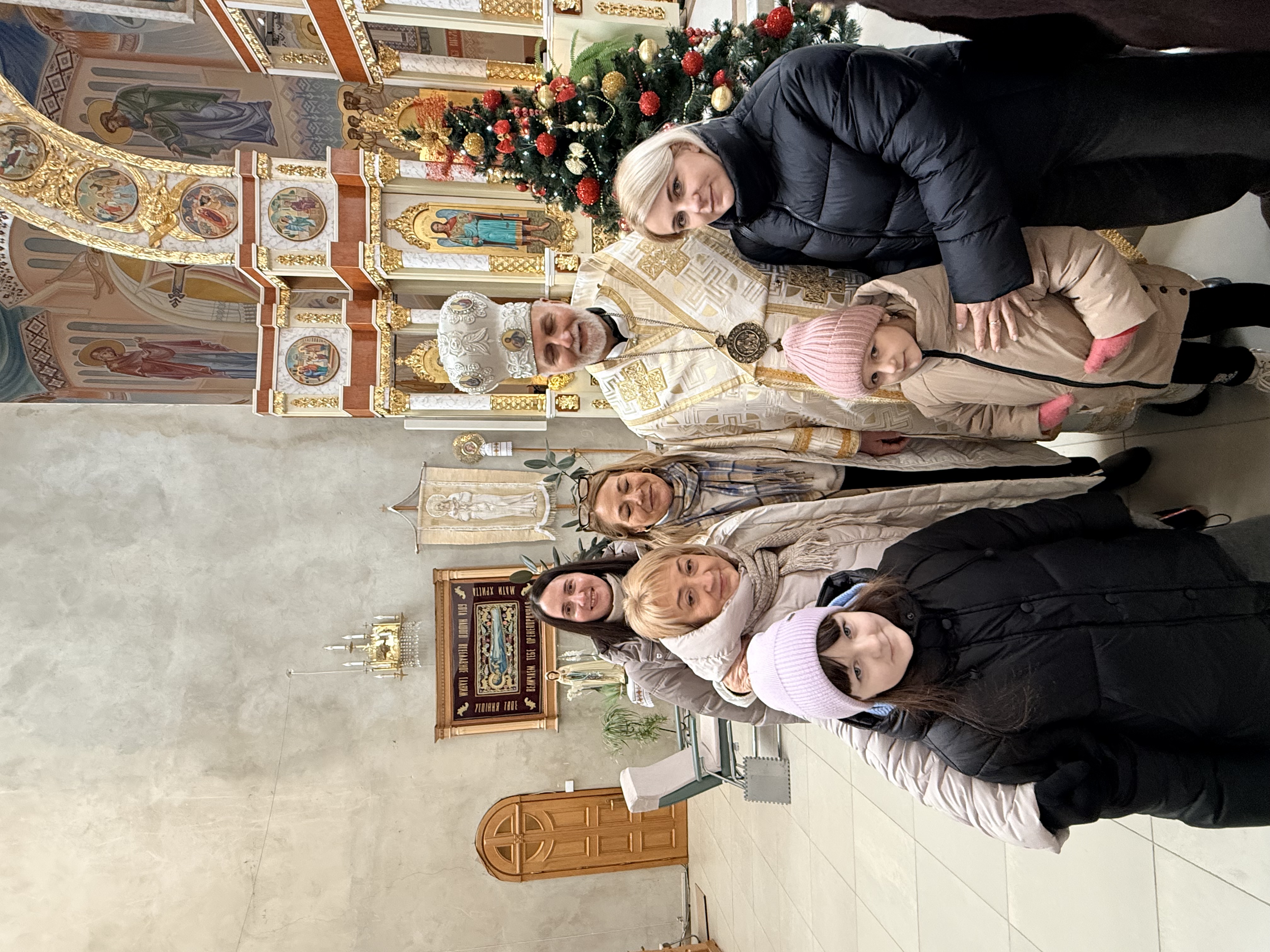
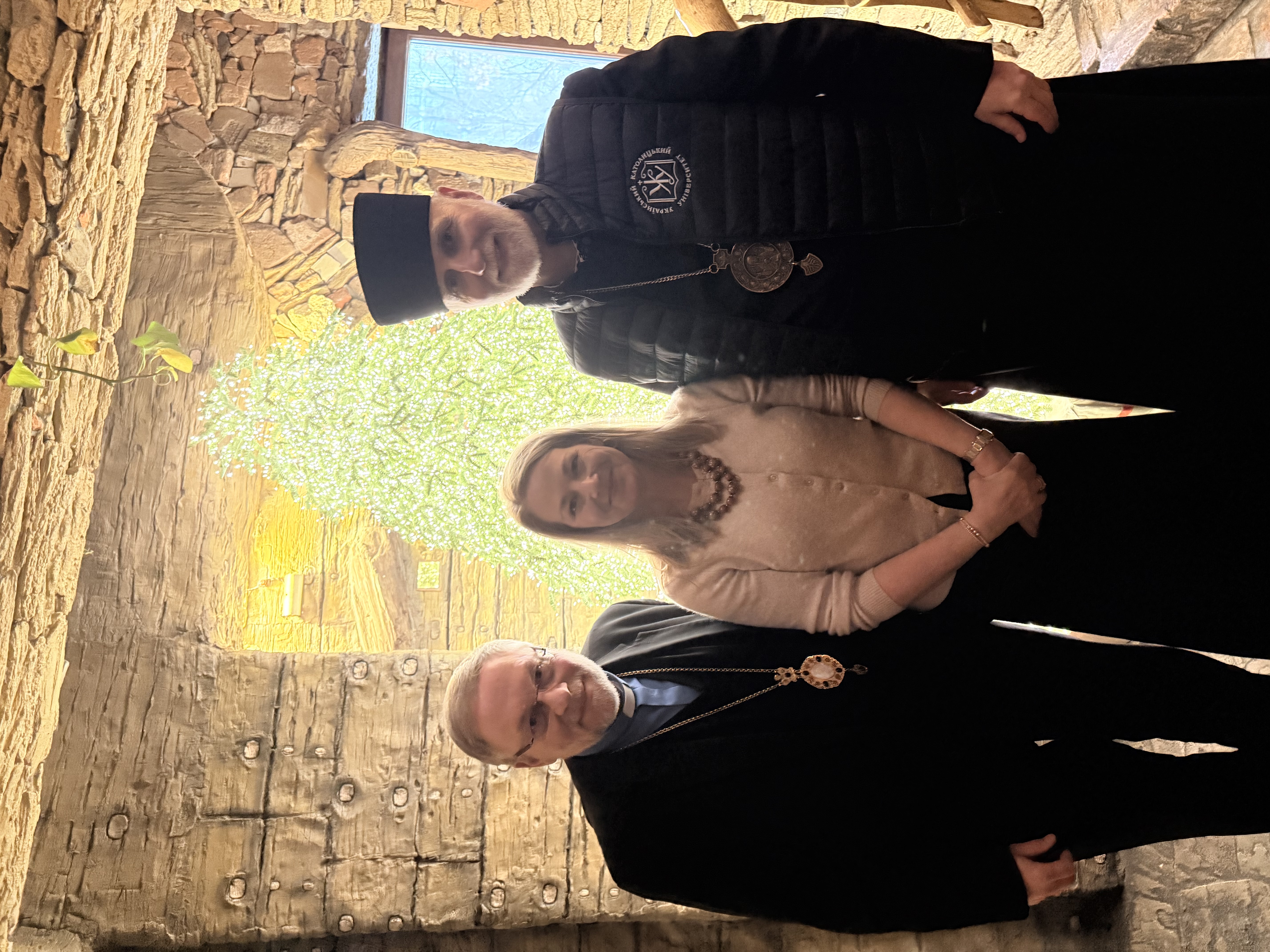
In my remarks, I mentioned that sometimes I feel I don't have the authority to say this, because although I'm of Ukrainian descent, I've never set foot in Ukraine. Afterward, the Archbishop came up to me and said, "Since you've never been to Ukraine, I'm going in September—you're invited to come with me." A couple of weeks later, Sofia Zacharczuk, the Archbishop's chief-of-staff, called and confirmed: "You are invited, and we would like you to join the trip." And that's how I went for the first time, in September 2025. Our trip was mainly focused on Lviv and the Ukrainian Catholic University.

My mom came with me. Her mother and father were forcibly resettled in Poland during World War II. The rest of her family went east, and they lost touch for years. Over time, the Red Cross was able to reunite them. After my mom came to America in the 1960s, she was able, in the 1970s, to reconnect with some of that family.

This time you went in winter and were able to visit Ivano-Frankivsk, Chernivtsi, Ternopil, and other smaller towns, as well as many Church projects. How was your second trip different?

During my second trip, in January 2026, I really got to see Ukraine outside of Lviv—at least the western part of the country. I enjoyed going into smaller towns and seeing life beyond a big city, and some of the challenges people in more rural areas are facing. I was very glad to have the opportunity dig a little deeper into what day-to-day life looks like for Ukrainians who live outside urban centers.

What was the most difficult moment for you during this trip?

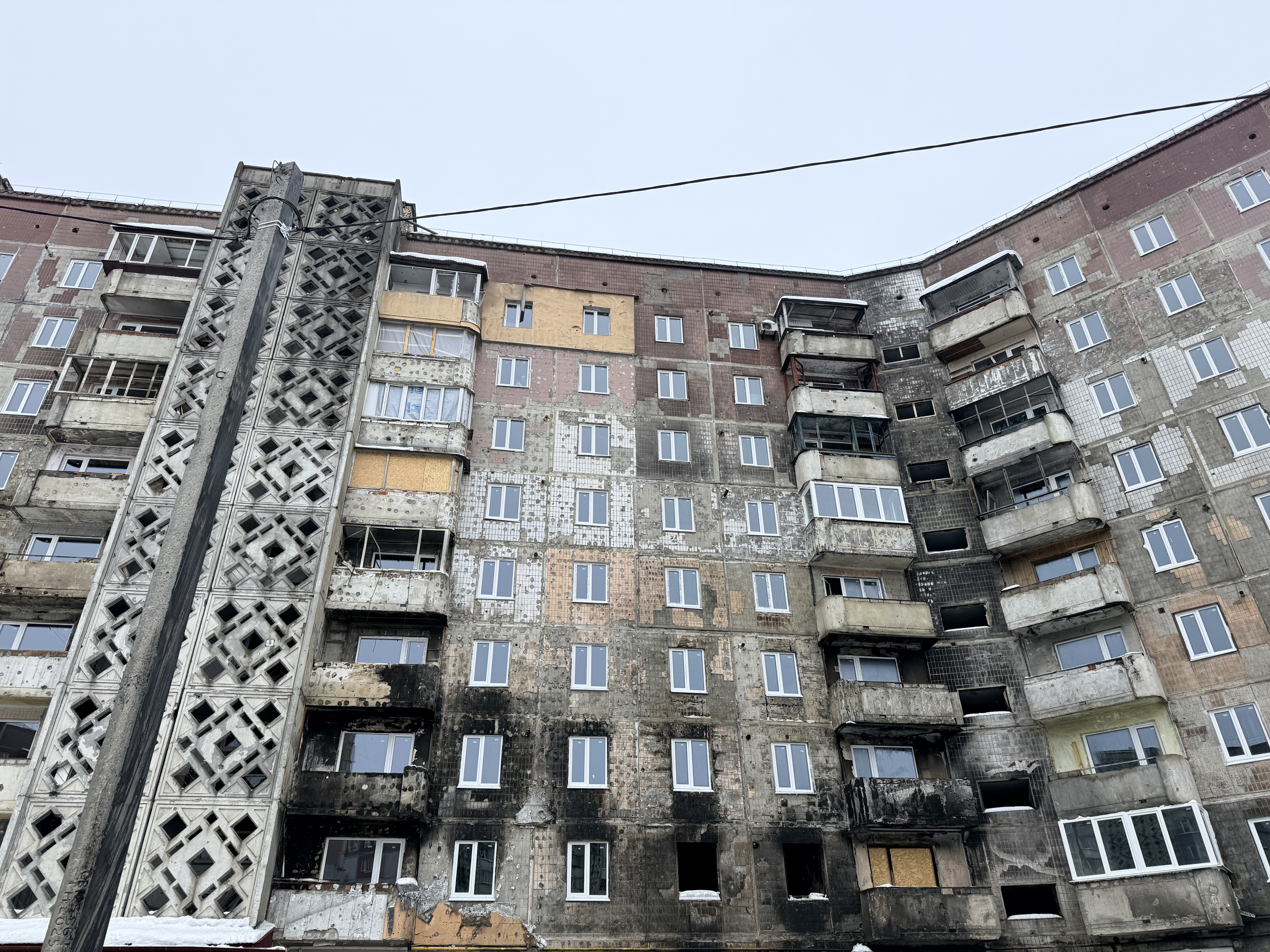
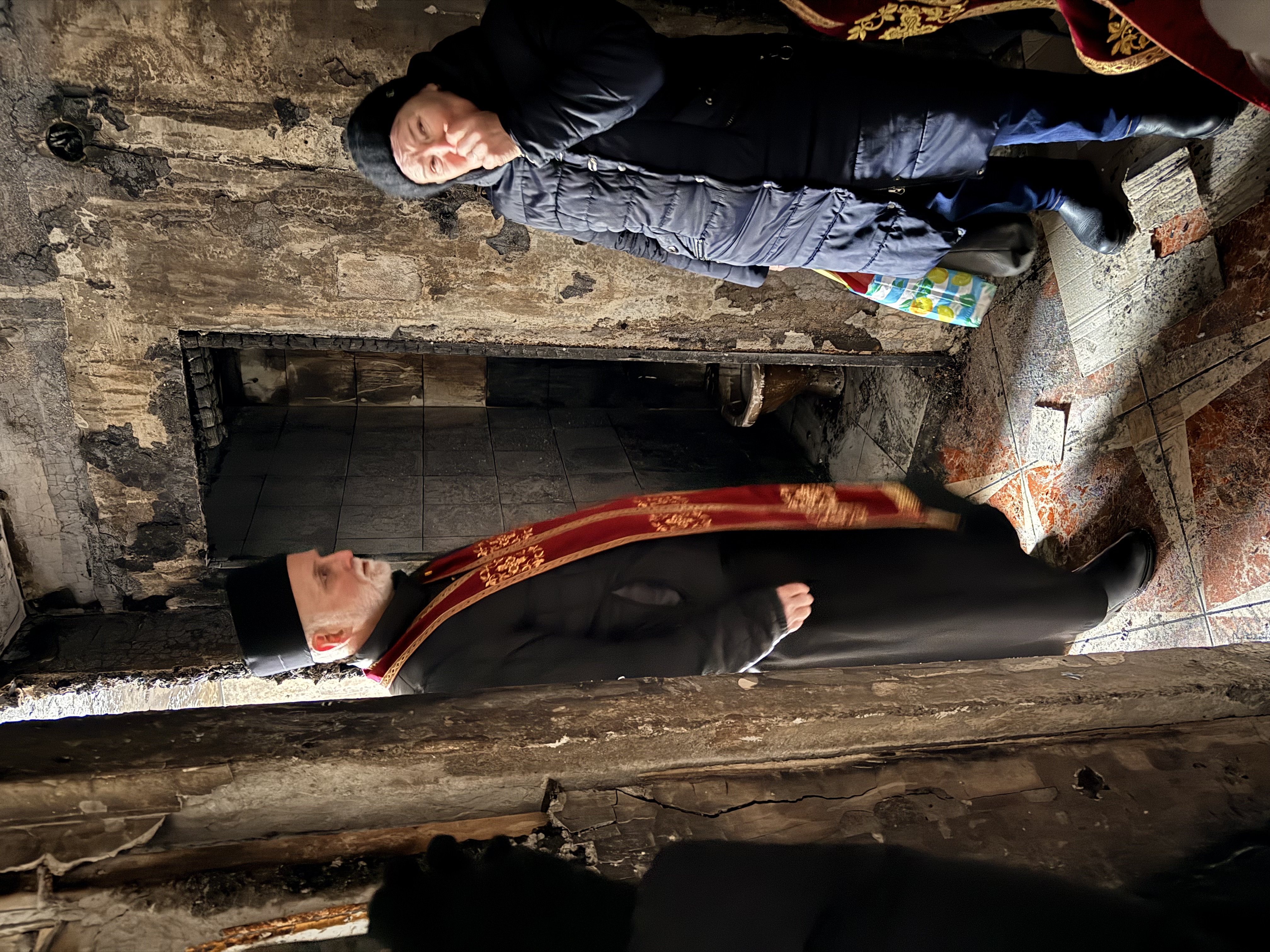
The most difficult was the day we were in Ternopil, when we walked through the building that had been struck by a missile [In November 2025, a Russian missile hit residential buildings there, killing at least 38 people]. Seeing the brutality of the fire damage—the melted metal, the concrete bowed outward—was hard. And the smell. You could still smell it.

Standing there, looking at the devastation and thinking about the horror of what must have happened, was incredibly difficult. These were friends and neighbors living together, living normal lives with their children, going to work—and suddenly they became targets of Russian aggression.

You encountered a great deal of suffering on this trip (you have talked to people who lost their loved ones and were forcefully displaced and you have seen the destruction). How did you cope with what you saw? How did you protect yourself emotionally?

Alongside that horror, I was also privileged to see the best in people. Because despite of the suffering, truly, the best in people is being revealed. I can't stop talking about how involved our Church is in making that happen—in bringing the best of people together.

I keep coming back to the House of Mercy we visited in Chortkiv, and the many different kinds of people taken in there. The accommodations are far from luxurious, yet all I kept hearing, over and over, was how grateful the residents are—for a place to be, and for a place where they feel a sense of community.

There were so many moments where I saw our Church, and the people of our Church, working to maintain dignity and as much normalcy as possible.

There was also a lot of laughter and warmth throughout the trip. Even as we talked about difficult things and hard situations, there was joy in the caroling and in being together. I really felt that, and it was beautiful.

Every trip teaches us something about ourselves. What did this experience reveal to you—as a Ukrainian, as a Ukrainian Catholic, and simply as a person?

It didn't teach me something entirely new, but it reinforced something I already believed: that as members of Christ's body, we are called to action. Our faith is a faith of action.

No matter where we are in life or what we do, we are called to help our brothers and sisters. That may look very different in my life, in my sister's life, or in my children's lives—but to be truly and fully Christian, you are called to help those around you.

It's up to us to listen to the Holy Spirit, who will guide us in what that looks like for each of us and for the people in our lives.

You are rediscovering and deepening your Ukrainian identity during a time of war. How has that changed what you share with others about being Ukrainian?

What I've discovered is that Ukrainian people are remarkably resilient, but also very open and driven to incorporate the best of classical liberal Western values into their society. They do that with incredible hospitality, warmth, and openness—even toward someone like me.

I was fully embraced, literally everywhere I went. All I heard, over and over, was "Thank you for coming." I felt it was a privilege to be there—to see and meet people doing the hard work of living through this and trying to build a better society.

That is what I share with people: the deep, positive spirit of the Ukrainian people. Whatever you feel about the politics, you should support the Ukrainian people.

I also plan to bring this story back to my parish—and, I hope, to other parishes in the Lehigh Valley—in hopes of generating material support for some of the programs and organizations I was able to visit.

Were you ever afraid during the trip?

Overall, I felt relatively safe. It was more the inconveniences than a constant sense of danger, at least in the areas where we traveled.

There was one moment that gave me pause. We were driving into Chernivtsi when the sirens went off. We were all in the van together, stuck in traffic, and I noted—we were just sitting there, and anything could have happened.
Many people who have never experienced war imagine it in certain ways. Did the reality match what you expected?

To be fair, people who live in westernized countries can't really understand what it means to live in a war zone—it's beyond our frame of reference. So I didn't have many expectations, mostly because I didn't know what I was going to see.

I was horrified by what I saw in Ternopil, and that will never leave me.

Another image that stays with me is from everyday life during our first trip. We were staying at the UCU dormitory, and the semester had just started. The very first night, we were exhausted—and then we spent four or five hours in the bomb shelter during an air alert over the city.

I have two children in college and a son in high school. When I went down there and saw that room full of students, I thought: these could be my kids. Every single one of them was the same age as my own children. That struck me deeply, and I think about it every day.

That first night, we talked with some of the students, and what stood out was that many of them were on their phones—checking apps to follow what was happening near their families, making sure their loved ones were safe. It wasn't just about the students themselves.

One young woman told us, "My brother is on the front line. My parents are in Odesa." She spent the first hour making sure everyone in her family was okay.

Do you hope to return to Ukraine?

I hope so. I hope I have another opportunity to go back. As much as I love Lviv—and I do; it's a beautiful city, and being on the UCU campus is something special, there's a kind of magic to the place—I really enjoyed getting out into smaller cities and towns and seeing the work being done by everyday people just holding their communities together.

That's something I'd love to keep exploring on a future visit.

What do you share with people in the United States when you talk about these trips?

During our first visit, we spent a lot of time on the UCU campus and visited Unbroken and SuperHumans in Lviv, organizations that work with military personnel and civilians who have lost limbs due to the war. The scale of those injuries was astounding.

I try to give people a sense of that scale—not just what an individual or a family is facing, but what it means for the country as a whole, and how Ukraine will be dealing with this for generations.

When I walked through that building in Ternopil, there really are no words. No matter how much you try to communicate it, you can never fully convey it. That's why it matters to go and see—to understand that this destruction is real.

If we don't work to stop it, this is what you get. And that's why I was grateful to be invited back, and to be able to talk about it here in the U.S. If even one person's perspective shifts in some way, then it's all worth it.

Text: Mariana Karapinka
Photos: Andrea Kochan Neagle

Related News

More News
Prayer, Encounters, and Solidarity: Metropolitan Borys Gudziak in Ternopil–Zboriv Archeparchy

#Ukraine

#Archeparchy

Prayer, Encounters, and Solidarity: Metropolitan Borys Gudziak in Ternopil–Zboriv Archeparchy