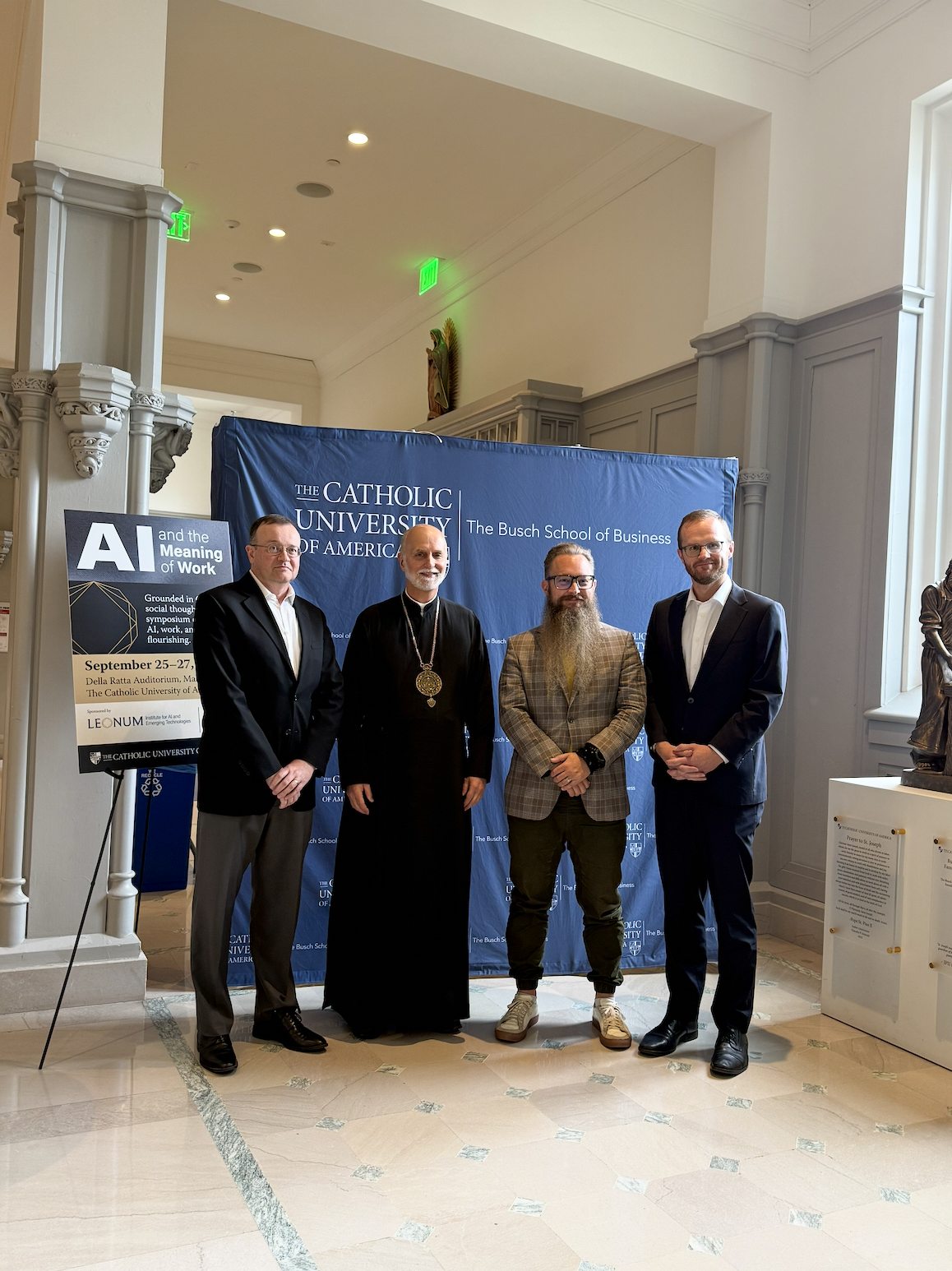
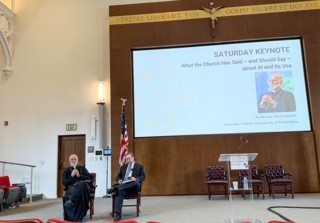
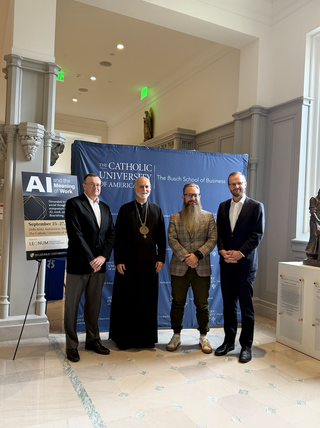
Metropolitan Borys Gudziak delivered a keynote address at the “AI and the Meaning of Work” Symposium, held September 25-27, 2026, in Washington, D.C. The symposium was co-sponsored by the Leonum Institute and the Word on Fire Institute and brought together participants for a discussion on artificial intelligence, the meaning and dignity of human work, and the challenges posed by rapidly developing technologies.
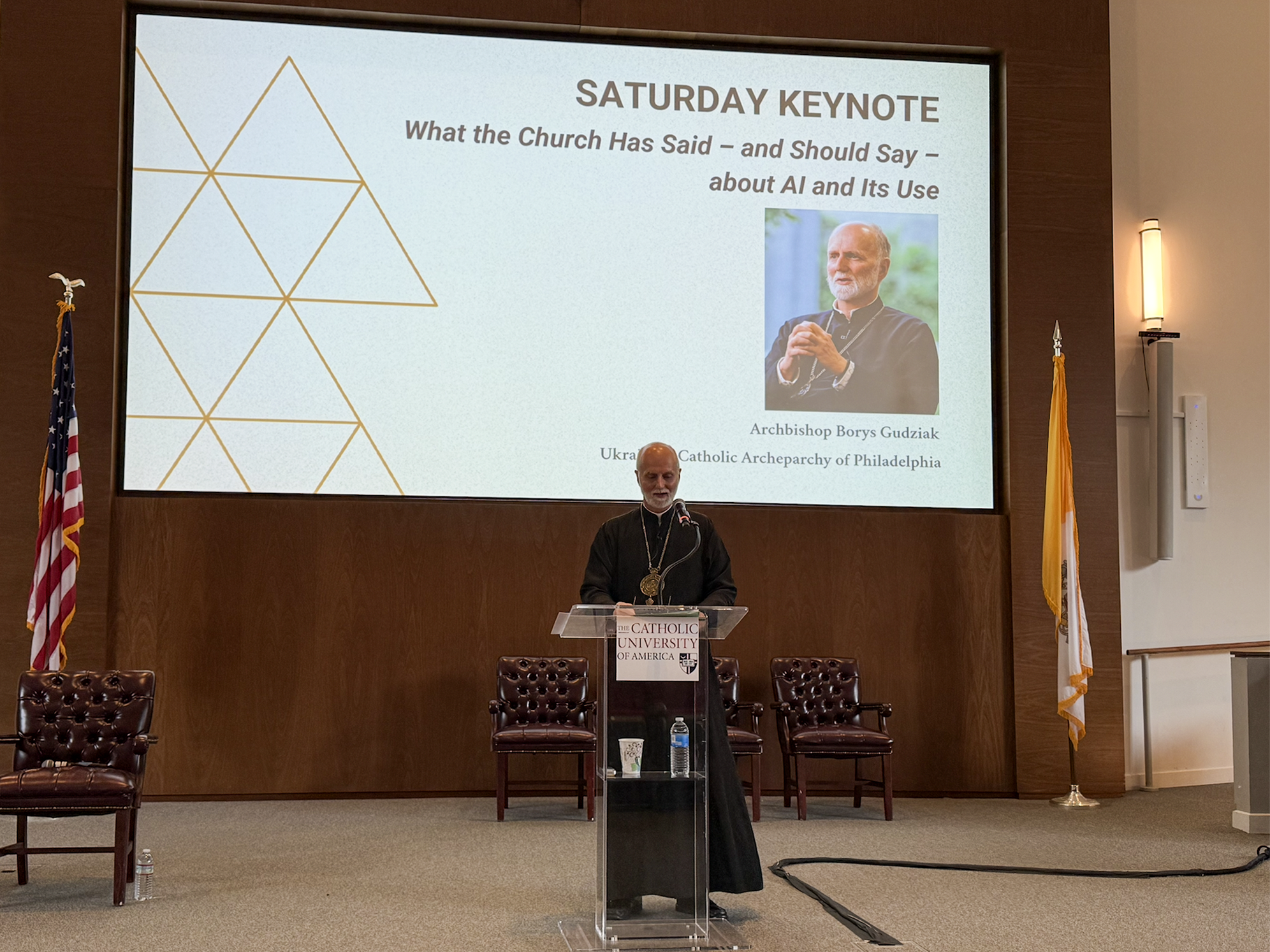
On Saturday, September 26, Archbishop Borys delivered the keynote address, “What the Church Has Said — and Should Say — about AI and Its Use.”
A significant part of his address was devoted to Magnifica humanitas and its vision of technological development in light of human dignity and the common good. Archbishop Borys reflected on the document’s use of the biblical images of the Tower of Babel and the rebuilding of the walls of Jerusalem as two contrasting approaches to human creativity and technological power. Technology, he emphasized, cannot be considered apart from the people and institutions that develop, finance, regulate, and use it.
The Archbishop addressed both the possibilities offered by artificial intelligence and the moral questions accompanying its rapid development. Among the issues he discussed were human responsibility for technological creation, the effect of AI on human relationships, education and employment, misinformation, the concentration of technological power, and the need for appropriate oversight and regulation.
He also spoke about the fundamental Christian understanding of human dignity as something that does not depend upon productivity, achievement, or technological capability, “A machine can be more efficient; it can materially outproduce us, and it increasingly will. If our dignity came from output, that would be a crisis. But it never did. Dignity was given at creation before we did anything.”
Archbishop Borys emphasized that this understanding becomes particularly important as artificial intelligence increasingly imitates forms of human communication and interaction, “AI can imitate relationship. It can remember your name, answer with warmth, never grow tired of you. But imitation is not communion. It can process our words. It cannot be beloved, and it cannot behold us as beloved, because it has no self to give and receive love the way Father, Son, and Spirit do.”
He suggested that technology should therefore be evaluated not simply according to what it is capable of accomplishing, but according to whether it serves authentic human flourishing and relationships.
The Archbishop also brought the experience of Ukraine into the discussion. Drawing on his recent visits to the country, he described how the war has become one of the most technologically intensive conflicts of the present day, with drones, autonomous systems, artificial intelligence, machine vision, robotic logistics, and AI-assisted targeting increasingly shaping the battlefield.
This reality, he noted, makes questions about AI and moral responsibility far more than theoretical. He spoke about Ukrainian engineers and graduates working in the defense sector and the responsibility of those who develop technologies to remain conscious of their consequences for human life. He also addressed the growing challenge of AI-enabled disinformation and the manipulation of data used to train artificial intelligence systems.
Looking toward the Church’s role in this rapidly changing environment, Archbishop Borys stressed the need for continued dialogue among theologians, philosophers, scientists, technologists, policymakers, and citizens. “The task is not to fear technology, but to ensure that technological power remains ordered toward the dignity and flourishing of the human person.”
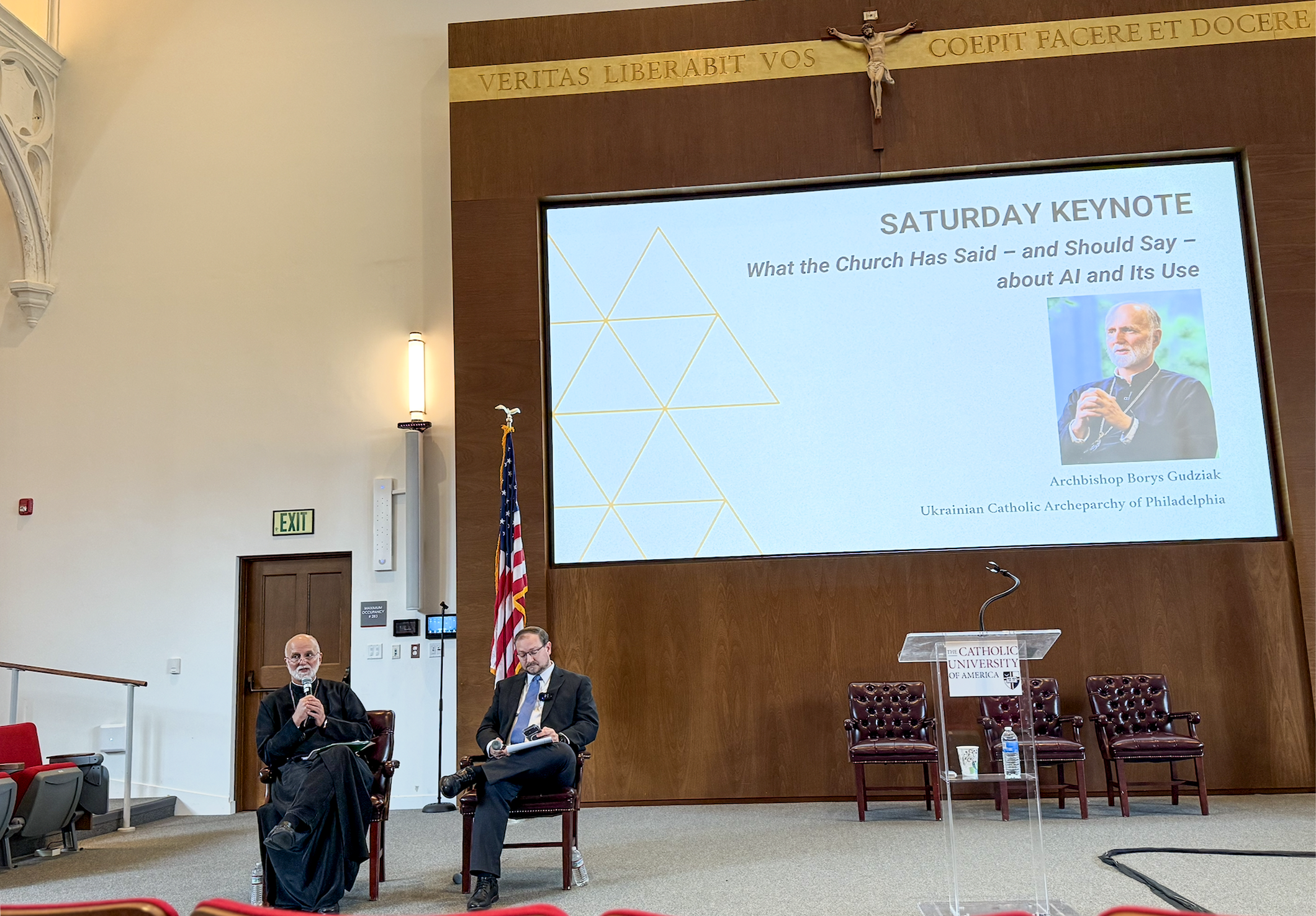
Following the keynote, Archbishop Borys participated in a QA session that further explored questions of AI, human personhood, technological power and responsibility, deterrence, and the Church’s witness in contemporary society. The discussion also touched on the experience of the Church and Ukrainian Catholic University during Russia’s war against Ukraine and the ways in which questions surrounding technology, ethics, and human dignity are already being confronted in practice.
Throughout his address and the discussion that followed, Archbishop Borys returned to a central Christian principle: human worth is not determined by what a person produces or achieves. Rather, every person possesses a God-given dignity rooted in being created in the image and likeness of God — a foundation that technological progress cannot replace.