- Strategic Resources
- Archeparchy
- Our faith
- Offices and ministries
- News and Updates
- Events
- Parishes
- Youth Protection
- Subscribe to "The Way"
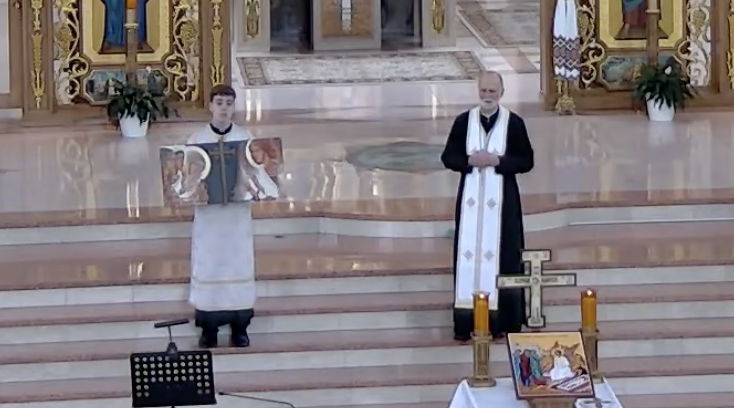
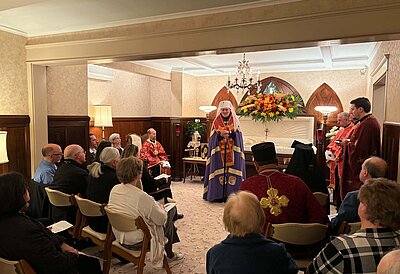
On the second Sunday after Pascha, dedicated in the Byzantine tradition to the Myrrh-Bearing Women, Metropolitan Borys Gudziak reflected on the depth of their experience—marked by grief, loss, and yet remarkable fidelity. He recalled that these women came to the tomb of Jesus after the trauma of the crucifixion, carrying myrrh to complete the burial rites according to Jewish custom. “They had experienced trauma, tragedy, and collapse,” he said, noting that “fear, trembling, and deep distress defined their experience.”
In this context, the Metropolitan highlighted their unique courage. At a moment when “everyone was afraid” and even the apostles had fled, these women remained faithful. Their presence at the tomb becomes a quiet but powerful witness—an expression of love that does not retreat even in the face of death.
It is precisely to them that the message of the Resurrection is first revealed—not in triumphal display, but in gentleness and light. “After the brutality of the crucifixion, in a delicate way, to these delicate women, it is announced: He is not in the tomb,” the Metropolitan said. In the darkness of the grave, Christ appears as the light that pierces not only that moment, but all of human history: “He came as the light of the world… to illuminate us.”
At the heart of the Resurrection is the gift of peace—a peace that echoes across all time: “Peace be with you—women, apostles, the world.” This, the Metropolitan emphasized, is not merely a greeting, but a proclamation of victory: “I have overcome death… and I say to each of you—peace be with you.” The Resurrection of Christ “is not only the rising of the body of Jesus of Nazareth, but it embraces all humanity and all of our human reality,” opening a horizon of life stronger than death.
This message resonates with particular urgency in today’s world. The Metropolitan spoke of the many manifestations of violence and fear that surround us: “Ukraine, the Middle East, Sudan,” as well as the daily tragedies and losses witnessed across the globe. In such a context, the Paschal message is not abstract—it speaks directly into the reality of human suffering.
He stressed that Christ’s victory is never imposed. “This is a gentle proposal of peace… a gift offered on an open hand, pierced by a nail.” It is a gift that can only be received, never forced: “Violence cannot overcome violence.” Christ conquers not through power, but through sacrifice—“through His own death and love”—and invites each person to freely accept this new life.
In conclusion, the Metropolitan called the faithful to allow this peace to transform their daily lives, especially in their relationships: “Let your relationships… be resurrected, peaceful. Let your family be a family of joy.” For it is precisely in the ordinary moments of life—in families, in workplaces, in human encounters—that the victory of the Risen Christ becomes visible. There, in what he described as a “quiet joy,” we begin to share in the experience of the Myrrh-Bearing Women—a joy born of encountering the living Christ.