- Lenten Appeal 2026
- Archeparchy
- Our faith
- Offices and ministries
- News and Updates
- Events
- Parishes
- Youth Protection
- Subscribe to "The Way"
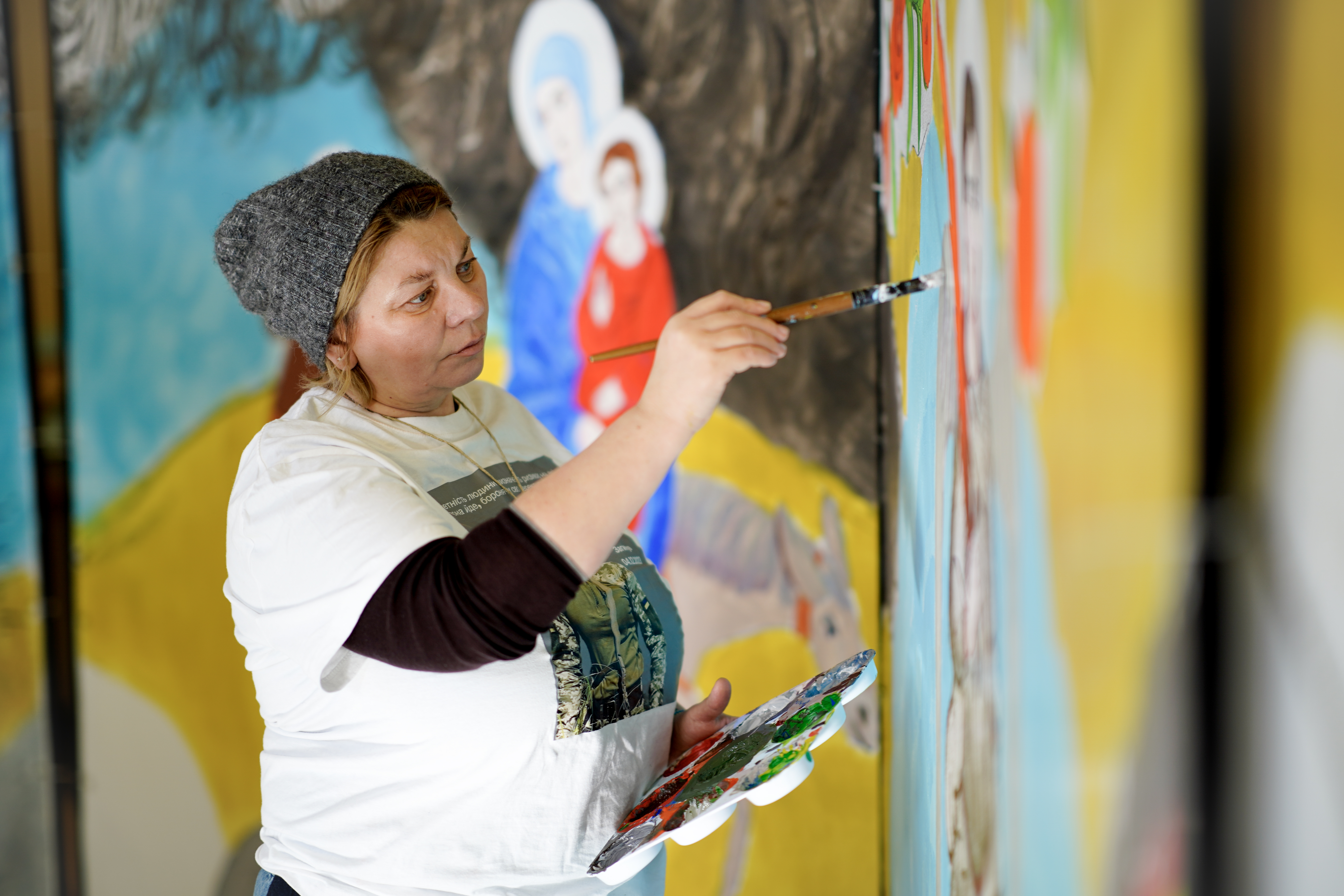
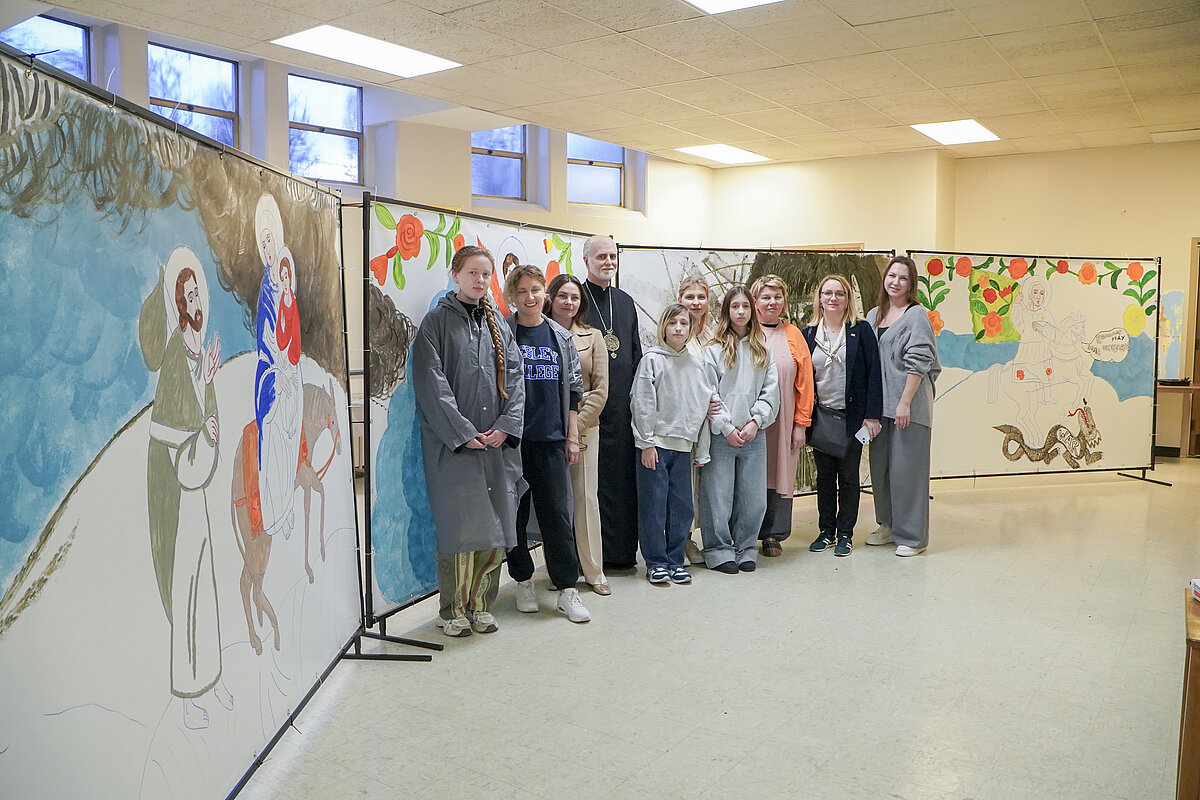
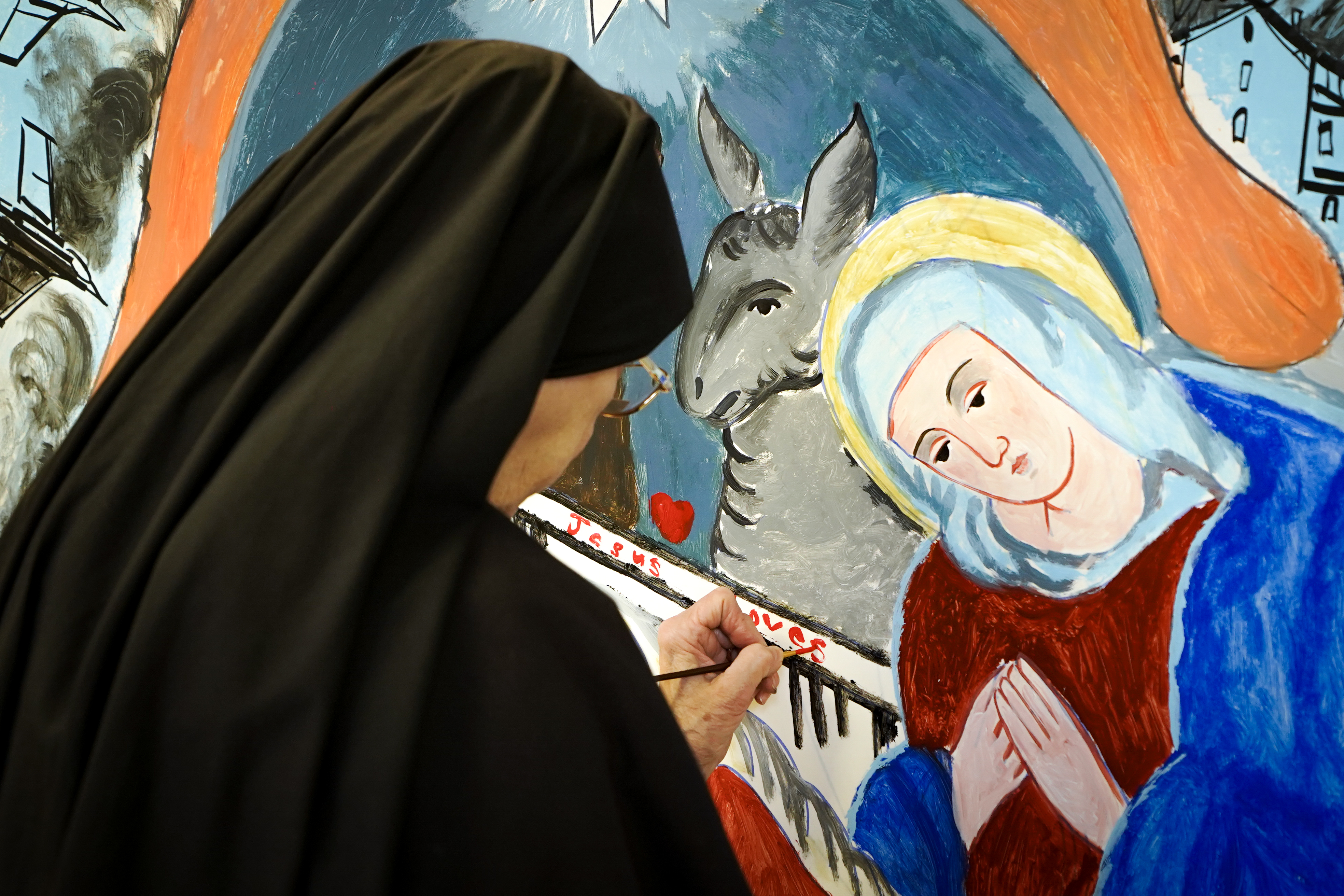
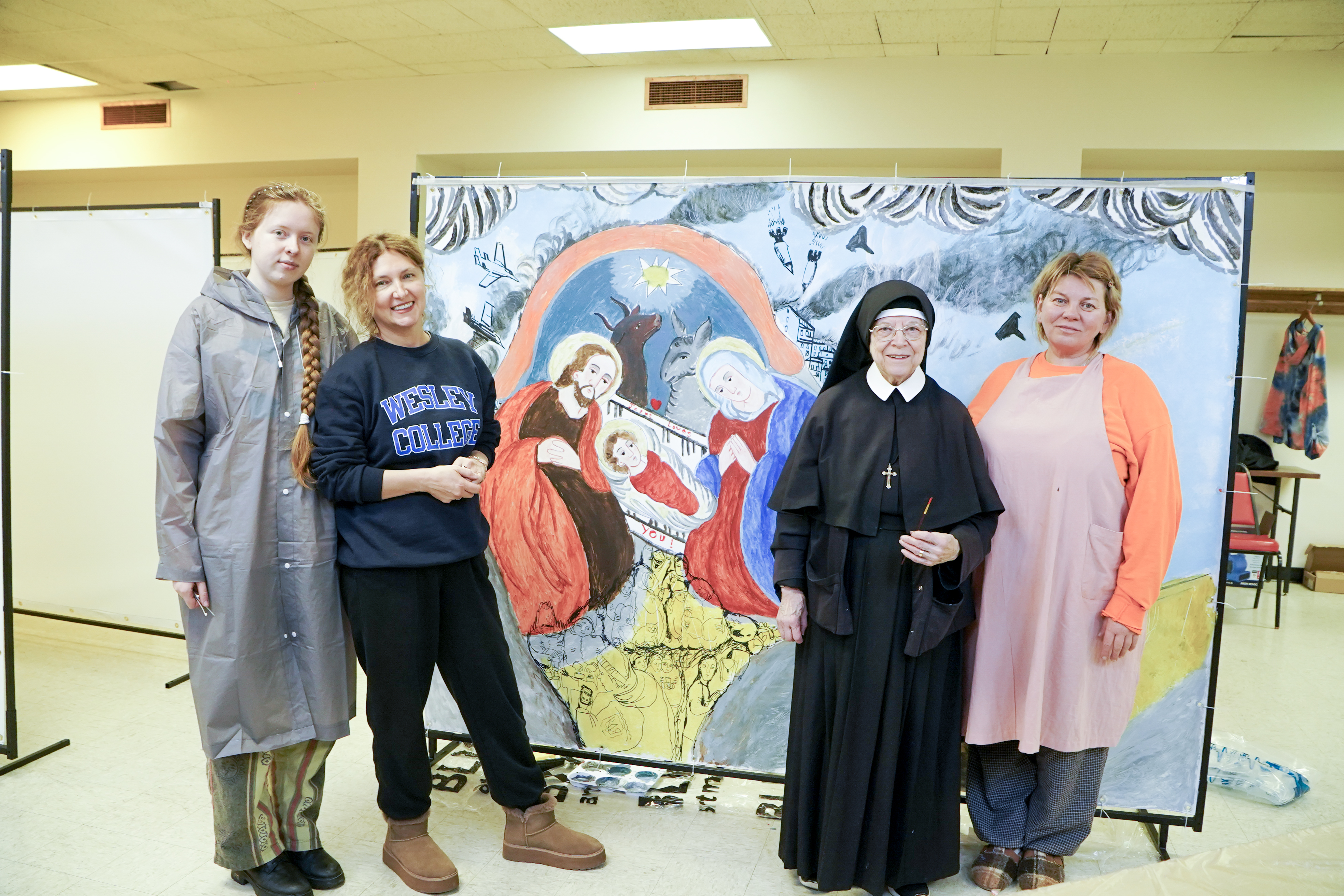
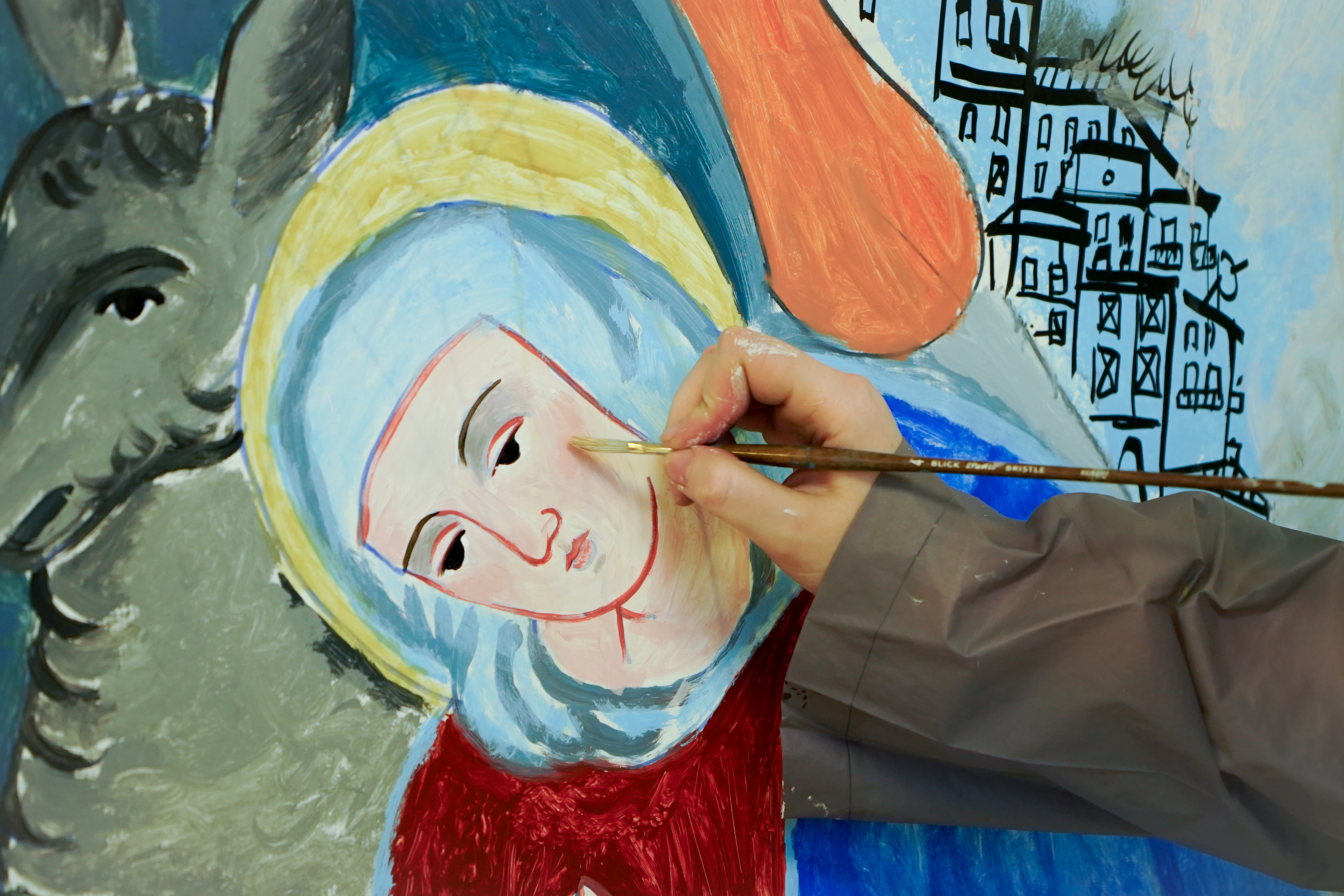
"A nation is its people," says artist Tetyana Mialkovska. That's why The Song of Songs of the Ukrainian People — which she's creating alongside Tetyana Rusetska and Iryna Semenenko — is so much more than a monumental canvas rooted in folk icon tradition. It's a living painting, one that will carry the marks of children, veterans, and everyone who walks through the door. Right now it's taking shape in the basement of the Cathedral of the Immaculate Conception in Philadelphia, and it will be unveiled on March 29.
Tell us about the concept.
We're going to sing The Song of Songs of the Ukrainian People through paint — about Ukraine, about its people, about traditions, about symbols, about pain, about war, and about the future we're longing for.
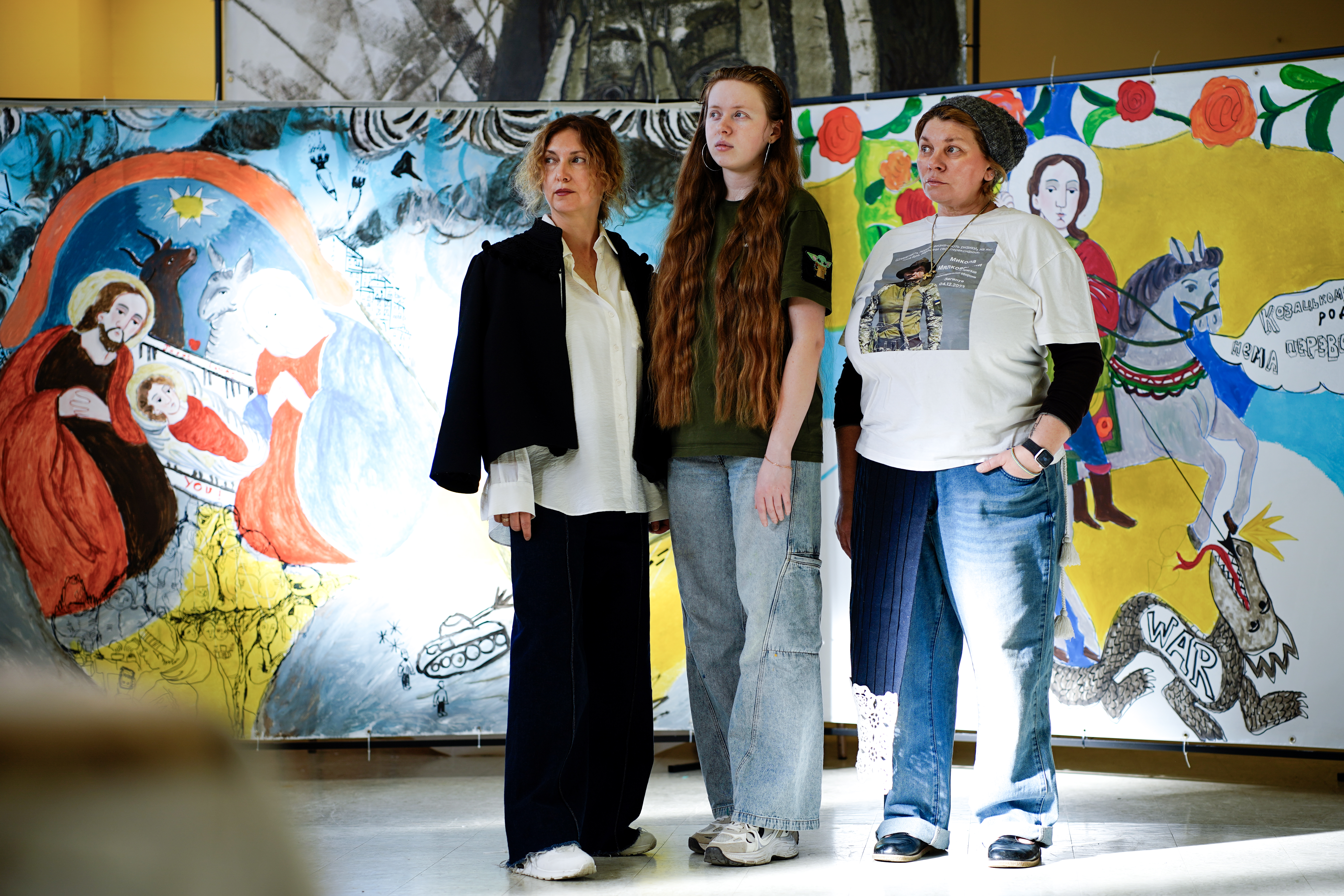
The whole thing will cover around 70 square meters. Each of the five modules is 2.30 meters tall and 2.5 meters wide, and together — double-sided — they make up the full painting. It draws on the most recognizable symbols of Ukrainian Christianity, taken from folk icon tradition, to show just how deep and authentic the spiritual life of the Ukrainian people really is. And at the same time, these symbols are being brought into the present.
The 30-meter painting unfolds across ten major scenes tracing the Christian year — the Nativity, the Annunciation, the Resurrection. It also brings in figures like the Archangel Gabriel, the Archangel Michael, and Saint George the Dragon-Slayer, woven together with fragments from domestic folk icons.
And it won't only be artists making this. Refugee children who fled Ukraine with their families will be part of it. So will soldiers who've lost limbs and are going through prosthetics treatment here in the States.
On the very last day — Palm Sunday, as people come out of church — everyone will take part in the final act. Each person will make their mark, leave their touch, to show just how present the people are. Everyone will paint their own sign. Hundreds of people will become part of this painting, co-creators of something alive.
So yes, three artists from Ukraine are building this — but throughout the whole process there will be moments of performance, of participation, open to people who've never thought of themselves as artists. Anyone who comes to us over the course of the month will have the chance to leave a visual trace. A nation is its people. That's the message we want to get across: people make life, people make a country, people make a nation.
Which regional icon tradition are you drawing from?
Many of them. All of Ukraine, really — Lemko icons, Hutsul icons, painted domestic icons. Some of these works are a hundred years apart, two hundred years apart — and it doesn't matter. We worked through archives, digital and physical, including the Honchar Museum, where we pulled fragments and identified them so the symbols would land as familiar.
We went looking for the most accessible symbols of a people who built their own culture with their own hands. So it makes sense that the people will paint this painting too. The work is called The Song of Songs of the Ukrainian People.
How do you imagine this work living on once it's finished?
The modules need to stand in front of the church for a while first — they need to find their place. It's like a newborn: you don't take a baby straight out into the world the moment it arrives. There's time needed, a settling in. A painting comes alive through the eyes that look at it — and then it starts to live its own life. People walking down the street should see it. People driving past should want to stop.
Each of the five modules is movable, and the whole thing is built to travel. That's the whole point — it should travel across America, telling Ukraine's story the way a song carries wherever the wind takes it. Schools, churches, wherever Ukrainian communities gather — and beyond. It could be shown at Ukrainian cultural festivals, or right in the heart of Washington on Independence Day, and people could gather around it, sing the anthem, take photos, hold each other.
It should become a kind of portal — a sanctuary that pulls a community together. Because a church isn't just a building. It's a place for living people, a community of people who share the same belief. And these modules can create a space where people look in the same direction — toward God, toward love for one another, toward building something intentional together. In our case, a Ukrainian community — because that's where our wound is, and that's what we need so badly right now.
What style do you usually work in?
I work in folk modern — but my imagery is largely sacred, built on Christian symbols, pulling from many different sources. Tetyana Rusetska also works deeply with sacred imagery. She knows this world well — not just as theory, but in her hands. Iryna Semenenko is just beginning her path as an iconographer, painting in the classical, canonical tradition.
We fit together really well. An artist working in contemporary art who brought a fresh way of seeing and reimagining the visual language; a keeper of classical iconography who joined us to paint the holy faces; and me — I took on the role of organizer.
We developed the concept together with Metropolitan Borys Gudziak. The team came together from the start. We met in Ukraine beforehand, stayed in constant touch. And through all of that shared work, we found our common ground.
It's a real challenge for us as professional artists. We have to hold onto our own voice while not copying what already exists. The line is delicate — it has to be interpretation, not imitation, and at the same time it has to leave room for the work of people who've never picked up a brush. There will be very small children. Elderly people. Most of them have no formal training. All of that has to come together into something whole.
Aren't you afraid they'll ruin it?
Not at all. Every time, they do the opposite — they add their own spice. Everyone brings something of themselves, and what comes out is so rich. When a person feels they're touching something luminous, something that matters, it's as if God steps in and helps them make something beautiful. I'm sure what we'll end up with will be extraordinary — not just a painting, but a living art object built around the most important thing: people finding each other. Getting to know one another through this work, because of this work.
Tell us about the charitable side of the project.
As artists, we're grateful — painting is what we love most in this life, and we're doing it with joy, with love. But our goal isn't just to satisfy something creative in ourselves. The deeper goal is to carry a message about Ukraine — to make something that draws attention to our pain. It's also, in its own way, a plea. A request for help from people who are able to give it. Because when someone is wounded, they can't heal themselves. They need someone to reach out. And that, really, is what Christianity is about. We want to say it out loud: we need help, and we want to receive it.
Every person in Ukraine right now is wounded — mentally or physically. And the need isn't only for physical help. It goes much deeper than that.
Our organization Pyaterna and our charitable foundation work with soldiers and children affected by the war. We run the Warm Palms camps — twenty-six or twenty-seven of them now, each welcoming fifty-five to sixty children. For ten days, we don't just give them rest. We offer a full program of art therapy, pastoral care, and psychological support. Ten days isn't long — but the children who leave are not the same children who arrived. They go home knowing these tools exist, and that they can keep working on themselves. To keep this program going, to grow it and adapt it, we need funding. That's why we're here. This is our third trip to the United States for this reason.
We published a calendar with photos of soldiers in art therapy sessions, each tool described — to spread awareness of what's possible. We've also put out catalogues and methodological materials to help others bring these approaches into different regions of Ukraine. For Easter, we want to run another Warm Palms camp. Children from Mykolaiv, Kherson Oblast, Sumy, and Zaporizhzhia are already waiting. We work with regional administrations, departments of youth affairs, social policy, veteran policy. These relationships have been built over many years.
The camps happen in Volhynia, at the Integration Center Zamlynnia, run by Father Jan Buras. He took what had long been abandoned and built something remarkable. It's a beautiful place — in the forest, near Lake Svityaz, completely safe, right on the border with Poland. A real corner of paradise. There are workshops, a chapel, rooms to sleep in. The space itself heals the children just by being what it is. There's daily prayer. Father Jan takes extraordinary care of them — he feeds them until they can barely move. There are horses, bicycles. And so much art therapy. The children work with clay, they paint, they weave. Every form of visual art becomes a tool. A full team works alongside them: a doctor, clinical psychologists, a psychiatrist.
How does painting help you personally?
Honestly, it's less the painting and more the work with people. For me right now, painting is a luxury. Since the full-scale invasion, I've been deep in civic work, and there's rarely time. But I love it more than I can say. I'm grateful for the moments when I can just dissolve into it — when the phone goes quiet and nothing pulls me away. Since 2014, since the war began, I've held a brush not as a tool for making art, but as a tool for healing. For restoring something in people that's been broken.
I started working with the guys from the ATO — soldiers going through rehabilitation in the early years of the war. And to this day, art is, for me, a way back to mental health for people who have been hurt. In this work, I heal too — because I need to stay occupied. Every moment of silence pulls me back into my grief (Tetyana's son, Mykola Mialkovskyi, volunteered to fight in February 2022 and was killed on December 4, 2023), and it's very hard to carry. So I work. A lot.
The war is so devastating that the guys can't do conventional therapy. This pain, these mental wounds — they can't be analyzed. Any memory, any attempt to look directly at what happened, becomes a trigger. So they don't want to see a psychologist. But they show up for art therapy — especially when they know their paintings will hang in galleries, including abroad. That it will be about Ukraine. In their own way, they become cultural diplomats. Ambassadors. It gives them a reason to show up fully, to really engage. They're not painting just for themselves. They're painting to show the world what Ukraine is — its beauty, and the pain the enemy brought.
And then they light up when I send them photos. That their painting sold. That someone received it as a gift. That it's hanging in a museum. Their whole sense of themselves shifts — just like that. They say: "Who would have ever thought my painting would end up in the Museum of Volhynian Icons? No — that couldn't be about me." They can barely believe it, even when they see it. But they are so proud. And it carries them. Because for a hero, it matters that people see him — that people honor him as a hero. That matters to them more than almost anything.
Interview by Maryana Karapinka
Text: Maryana Karapinka and Oksana Loziak
Photos: Halyna Vasylytsia, Oksana Loziak, and from Tetyana Mialkovska's personal archive