“A Priest Is Not Formed Alone”: Fr. Ruslan Borovyi on Vocation, Community, and Ministry

The central theme of the 2026 Synod of Bishops of the Ukrainian Greek Catholic Church is “The Pastoral Care of Vocations to the Priesthood and Religious Life.” In connection with this theme, we invite you to discover the story of Fr. Ruslan Borovyi’s priestly vocation - the people and communities who helped him discern God’s call, and the experiences that shaped him as a priest and pastor.

We will continue to share other stories of priestly and religious vocations.

Fr. Ruslan Borovyi grew up in Bukovyna, a region where Ukrainian Greek Catholics remain a small minority and priestly ministry has long had a missionary character. The priests who have served there - and those who continue to serve there - have done so with extraordinary dedication. Their example - especially that of his father - shaped his understanding of vocation long before he considered becoming a priest himself.


Before priesthood became your own vocation, you first encountered it through the lives of others. Who showed you what it truly means to be a priest?

     I think my father’s example drew me toward the priesthood more than anything else. I saw how deeply he loved God, and I saw how deeply he loved people. Those two things were never separate. They still aren’t.

     I never remember a moment in my father’s priesthood when he looked down on people or placed himself above them. I never saw him despise people or distance himself from them. He was simply present with them. His love for God always became love for people. This is how Jesus loves us.

   For me, priesthood was not something I first encountered in books or as a theological concept. I saw it lived out before me. I saw a priest who was also a father, a person who shared people’s joys and struggles, someone who walked with them. My father never treated priesthood as a profession he expected me to follow. He never said, ‘This is what you should become.’ I simply saw that this was a way of life. And slowly, step by step, I began to recognize that maybe God was inviting me into the same kind of life - a life of loving God and loving people.

Many people imagine a vocation as a dramatic moment — a sudden realization, almost like the conversion of St. Paul on the road to Damascus. Was your experience like that? Was there a specific moment when you knew: “This is what God is calling me to do,” or was it something that unfolded gradually over time?

     For me, it was not a St. Paul moment. My vocation was never a lightning bolt from the sky. It was much quieter. It was more about learning to recognize where God was already present in my life.

     Looking back, I can see that my vocation was formed not by one extraordinary event but by many ordinary moments - through my family, through the priests I knew, through the communities I grew up in, and through the experiences God placed in my life.

     Step by step, I began to understand who I am, where I came from, and how God was already working through all of it. The first response to God’s call matters. But what matters even more is continuing to say "yes" every day. A vocation is not one decision. It is a lifelong pilgrimage. For me, priesthood is not a job from nine to five. It is simply my life. And in that sense, it is actually very easy to be a priest, because it is who I am.

There is an African proverb that says, “It takes a village to raise a child.” Perhaps, in the life of the Church, we could say: “It takes a parish to raise a priest.” Do you believe that a priestly vocation is something formed not only within a family, but within an entire community — a community that prays, witnesses faith, and shows a young person the beauty of giving one’s life to God and to others?

     One of the most beautiful and, at the same time, challenging statements in the Creed is: “I believe in the Church.” We don't say, “I believe in this church building.” The building simply exists, it does not require our faith. We can see it. But to say, “I believe in the Church,” means that we believe in a mystery. We believe in a community that God creates.

     Christianity is not something we live alone. No one baptizes himself.

     A young person needs a community where faith is alive. A community that prays. A community that values sacrifice. A community that serves others. That is the kind of environment where vocations grow.

    Looking back at my own life, I realize how blessed I was to grow up among people who truly loved the Church. I saw priests who served with extraordinary dedication. I saw parishioners who valued prayer and supported one another and their parishes. Those communities helped me discern my vocation. But I also came to understand that a vocation is never my private possession. It is not something I keep for myself. It is something given for others.

      It takes people who pray for vocations. It takes people who encourage young people. It takes people who show, through their own lives, that following Christ is not only a duty — it is a joy.

When you meet a young person who may have a vocation to the priesthood, what do you see first? Do you see someone who needs to be encouraged toward a particular path, or someone who needs help listening more deeply to what God is already saying in his heart?

       When I meet someone who may have a vocation to the priesthood, I don't try to recruit him. My task is not to convince him to become a priest but to help him discern what God is asking of him. A vocation cannot be imposed from the outside; it can only be freely embraced.

       What I try to do is help a person listen. God speaks to each of us differently. He speaks through our gifts. Through our talents. Through our wounds. Through our experiences. Even through our doubts.

       Sometimes a person is not looking for a vocation because he does not believe he is worthy. Sometimes he does not recognize that God may already be working in his life. Sometimes the most important thing we can help someone understand is one simple truth: You are beloved. And maybe that is the heart of every vocation - to discover that love and then share it with others.

       If someone is called to the priesthood, his vocation will not simply be about becoming a priest. It will be about helping other people discover that they, too, are beloved. Our role is not to force an answer.

       Not long ago, I received a video message from a young priest I had never met. His sister had once been a parishioner in the church where I served in Ukraine, and he told me that her stories about parish life had helped him discern his vocation. That was a great joy for me. It reminded me

that vocation is shaped less by what we say than by how we live. A joyful priest becomes an invitation.

You mentioned the idea of the “wounded healer” - that a person can help others not because they are perfect, but because they themselves have experienced God’s mercy and healing. How has your own humanity - your own struggles, weaknesses, and wounds - shaped the way you accompany people as a priest?

       For many years, I understood priesthood in one way. But today, maybe even more than when I first entered the seminary, I understand something deeper. I understand what Henri Nouwen called the “wounded healer.” A priest is not someone who stands above people as if he has everything figured out. A priest is someone who knows that he also needs God’s mercy. Through his own wounds, he can tell another person: "God has not stopped loving you." Despite your wounds. Despite your failures. Despite your successes.

       A married priest who has lost a child may never find the right words. But he can show that it is possible to live through such pain without losing trust in God. In my own life, raising a son with special needs has changed how I see everything. I understand fears, questions, isolation, misunderstanding and struggles that many families quietly carry. Our wounds do not make us better priests. But they help us stand beside people not only with words, but with our own lives.

       Through our own wounds, we can show another person that they are still beloved.
After many years of priestly ministry in different communities, how would you answer someone who asked: “What is the first and most important task of a priest?”

      For me, the first task of a priest is: to love God by loving the people He has entrusted to me. Before celebrating the sacraments. Before taking care of the church building. Before managing the parish. Before worrying about finances or administration. Before meetings. All these things are important. They are part of parish life. But they all begin with love.

      This is not the key to success, because ministry is not always successful. But I believe it is the key to faithfulness. If I truly love the people God has entrusted to me, then everything else—the preaching, the sacraments, the administration—finds its proper place. For me, that is priesthood.

You have experienced priesthood both in Ukraine and in the United States, in communities with very different histories, cultures, and needs. How has serving in such a diverse environment changed your understanding of what it means to be a pastor and to truly love the people entrusted to you?

     Serving in Ukraine and in the United States has taught me that every parish has its own challenges. In one parish I may meet people from different countries, different generations, and very different life experiences. They may even disagree about politics, culture, or questions related to the Church. That is not always easy for a priest.

     I have learned that being a pastor does not mean making everyone think the same way. It means loving everyone God has entrusted to me, even when we see things differently. I cannot choose whom to love. Every person is part of the flock God has given me. Every Sunday we stand

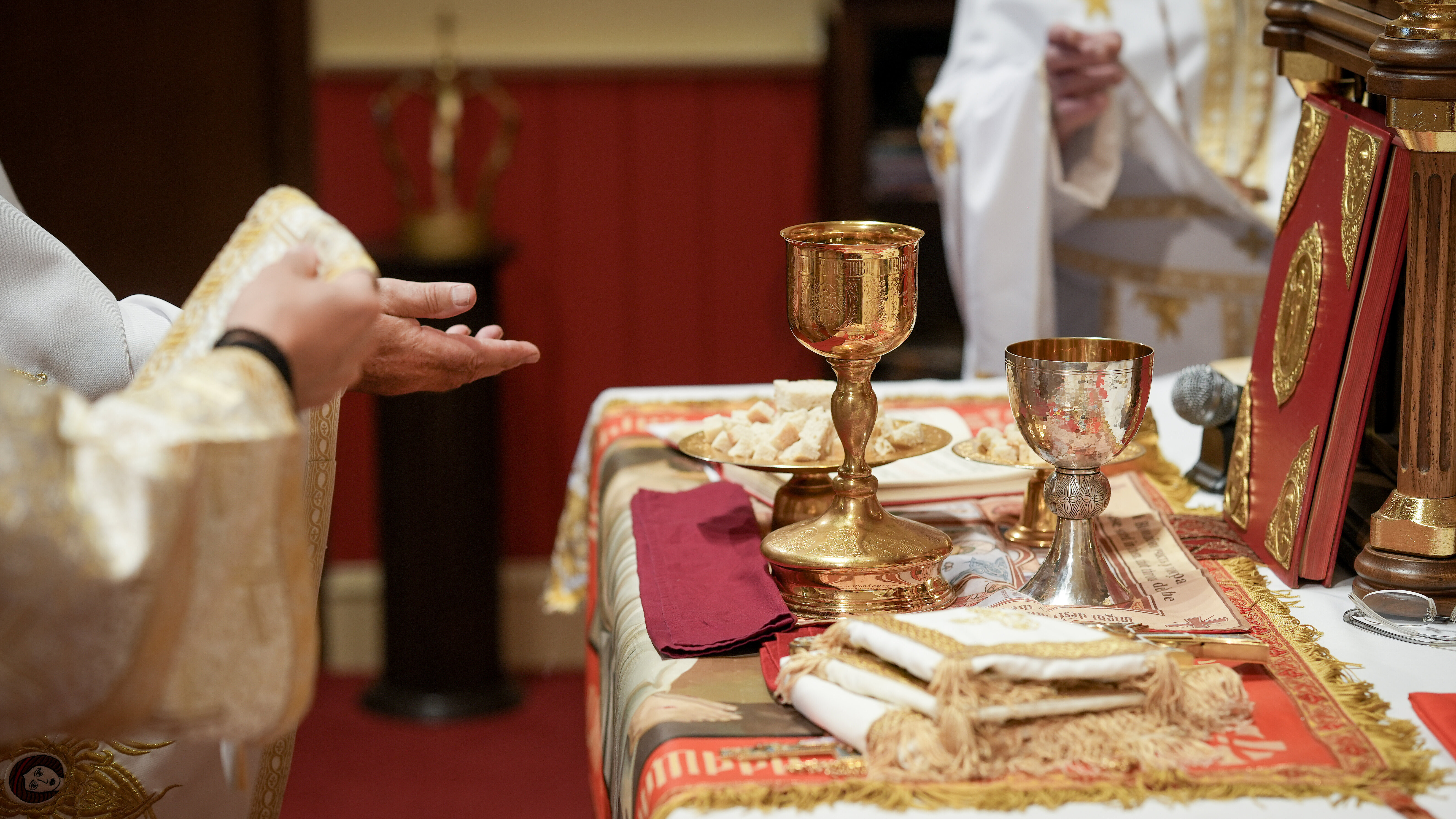
together around the same Divine Liturgy. We receive the same Body and Blood of Christ, even though we may disagree about many things.

     Perhaps that is what God has been teaching me here: not to love people because they are like me, but because they already belong to Him.


Interview by Halyna Vasylytsia

Related News

More News
Metropolitan Borys Gudziak Took Part in the 2026 Synod of Bishops of the UGCC

#U.S.

#Ukraine

#Archeparchy

Metropolitan Borys Gudziak Took Part in the 2026 Synod of Bishops of the UGCC

National Eucharistic Pilgrimage Concludes in Philadelphia

#U.S.

#Vatican

#Archeparchy

National Eucharistic Pilgrimage Concludes in Philadelphia

A Place to Shape the Future: New Plast Center Blessed and Opened in Zarvanytsia

Photo by Vlad Kravchuk

#Ukraine

#Archeparchy

A Place to Shape the Future: New Plast Center Blessed and Opened in Zarvanytsia

#U.S.

#Vatican

#Archeparchy

Letter of His Holiness Pope Leo XIV on the 250th Anniversary of the Founding of the United States of America