- Christmas Appeal 2026
- Archeparchy
- Our faith
- Offices and ministries
- News and Updates
- Events
- Parishes
- Child Protection
- Ways to Give
- Subscribe to "The Way"
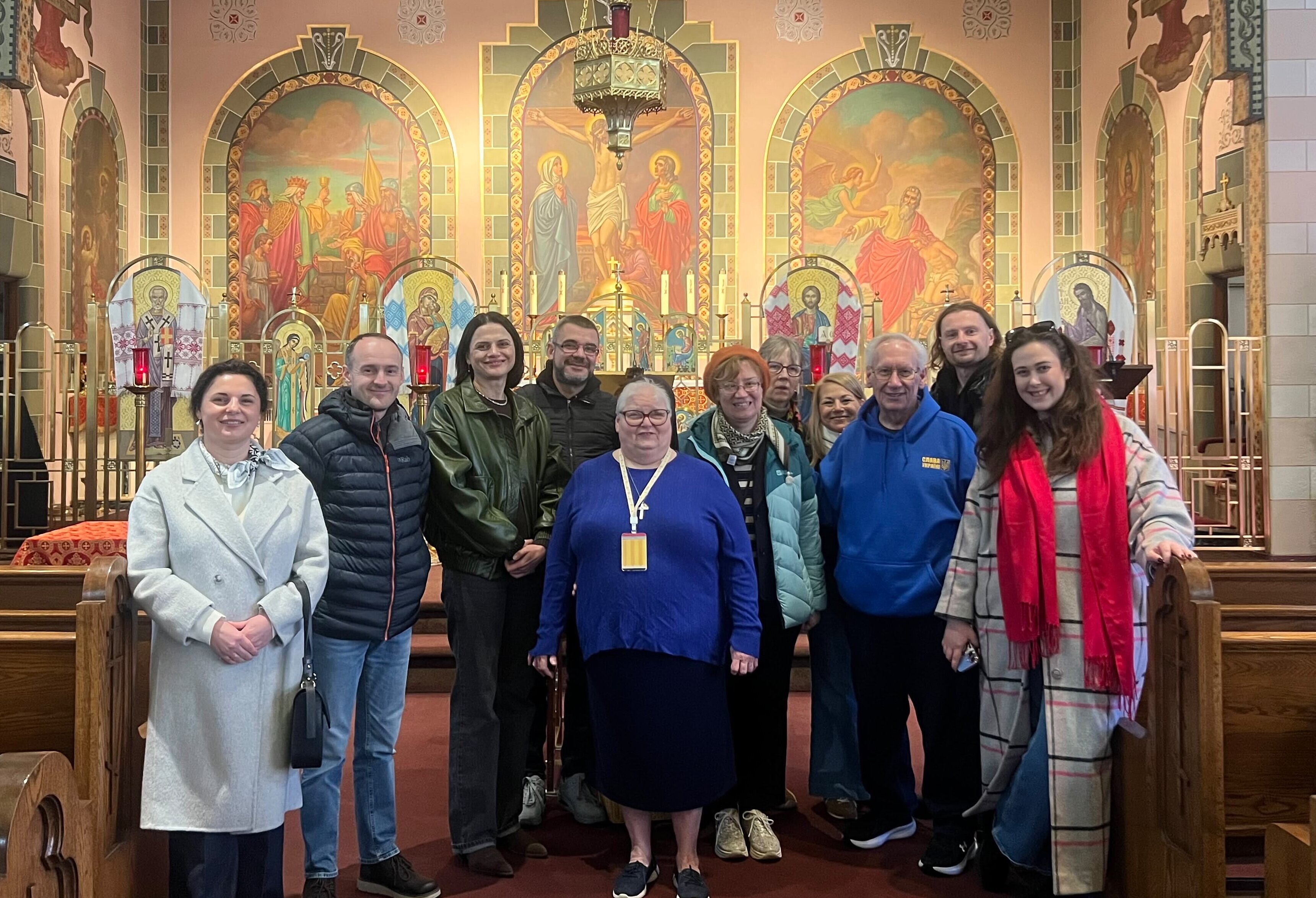
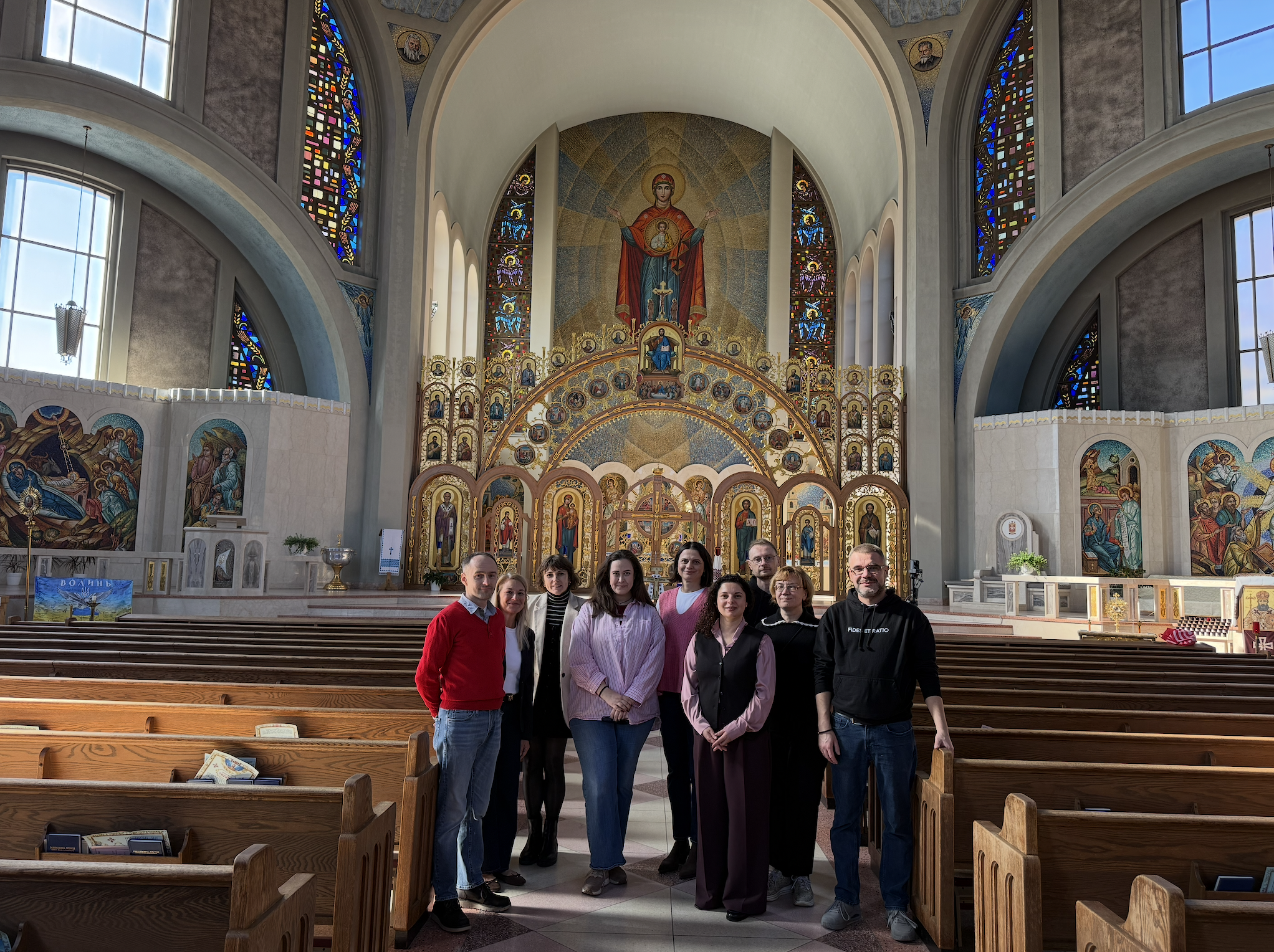
In November 2026, a delegation from Ukrainian Catholic University (UCU) in Lviv, Ukraine, visited the Ukrainian Catholic Archeparchy of Philadelphia.
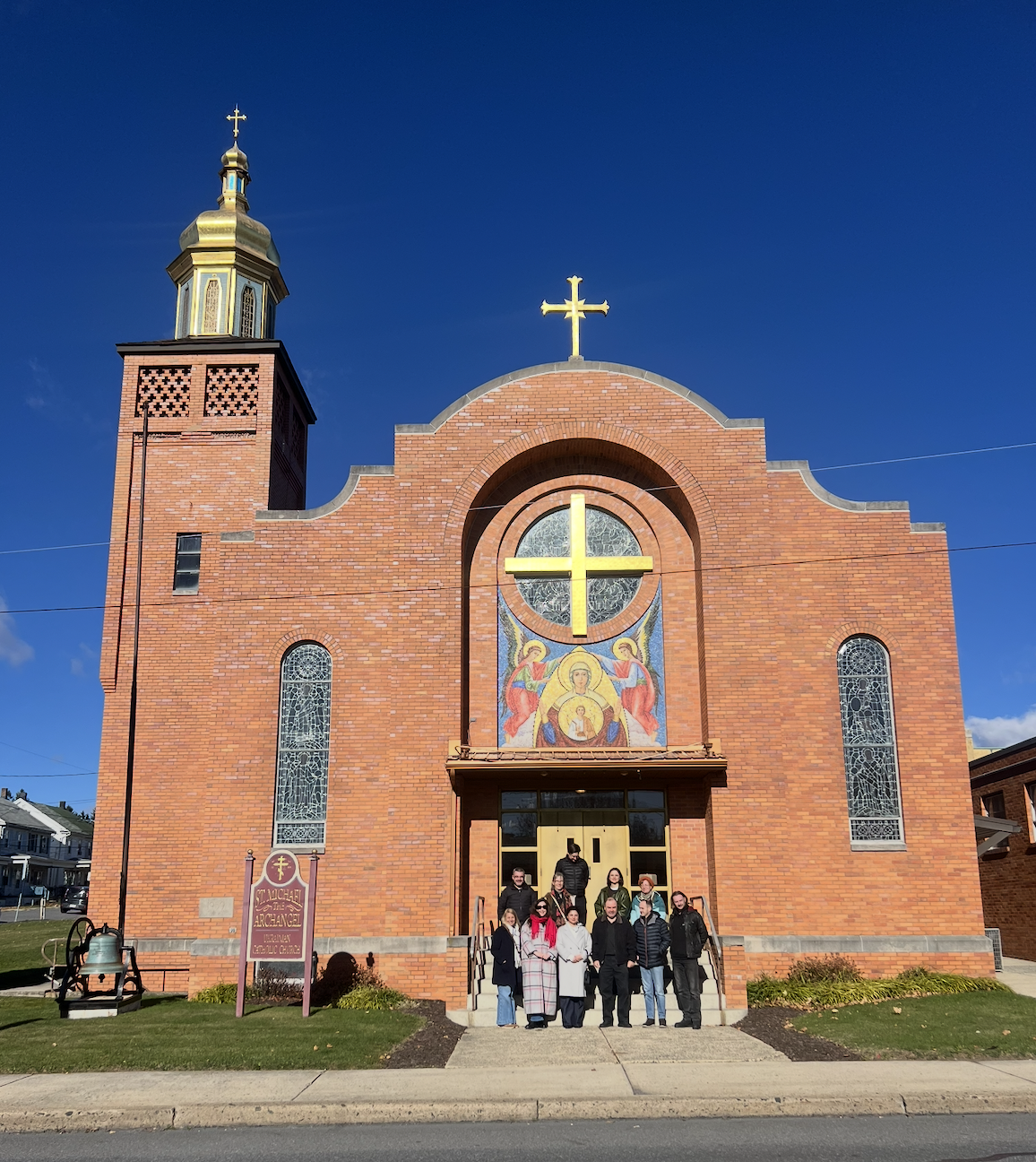
A particularly meaningful part of the visit was a trip to Pennsylvania's Anthracite Region on November 24. It was here, in the late nineteenth century, that some of the first Ukrainian Greek Catholic communities in the United States were established.
Exploring historic churches, visiting a Ukrainian Catholic school, and meeting with priests and parishioners prompted the guests to reflect on the history of Ukrainian immigration, the role of the Church in preserving national identity, the challenges facing parish communities today, and the responsibility of preserving their spiritual and cultural heritage.
Representatives of Ukrainian Catholic University shared their personal reflections with the Communications Department of the Ukrainian Catholic Archeparchy of Philadelphia.
Rev. Nazariy Mysyakovskyy, Deputy Rector for Spirituality at UCU
Seeing the first churches built by Ukrainians in America today, I was deeply and especially moved by the story of their birth. A birth founded upon the sweat, blood, and bones of our Ukrainian people.
At the same time, one can sense the enduring love of God among Ukrainians. They built not merely simple churches, but magnificent, beautiful, spacious buildings that captivate us with their beauty.
For me personally, it was a unique experience to touch, with my eyes and heart, something that has yet to be fully explored and described — something human and divine in the love shared with one another.
In each of the churches we visited, I prayed sincerely at the holy altar, with profound gratitude for every Ukrainian man and woman who contributed to the birth of these churches.
Iryna Starovoyt, Dean of the Faculty of Humanities at UCU
Minersville, Frackville, Centralia, Shamokin, Shenandoah — until yesterday, these were distant, unfamiliar points on a map of northeastern Pennsylvania. Their names sounded like incantations. Through our one-day pilgrimage, they became filled with people, meaning, and experience.
A century and a half ago, the Anthracite Region became a driving force of the American Industrial Revolution. To sustain its rapid development, the country needed steel, coal, and working minds and hands. The abundant deposits beneath Pennsylvania's mountains provided the former. The latter were embodied by immigrants, including those from the Carpathian Mountains and Transcarpathia.
Those who cross the sea change their skies, not their souls. The immigrants brought with them their faith, their rite, and the understanding that they would not return to their homeland and would therefore have to recreate it here. The churches where we prayed and where Ukrainian pastors welcomed us are breathtakingly beautiful and exceptionally well cared for. They were built by people of great faith who felt the need for Ukrainian community and unity.
Just a couple of decades ago, these churches were centers and magnets for large parish communities. Today, the region itself is experiencing depopulation as former mining towns and villages are dying out. The issue, therefore, is not the decline of our communities, but rather that the center of gravity has shifted elsewhere. And so we have this heritage — genuine, authentic, and sacred. The real question is how best to care for it in the absence of local heirs.
The strength of this place lies precisely in its interconnectedness. This is not a single sacred site, but an entire constellation. As we consider a new life and purpose for these sacred places in a new century, we must be as courageous as the miners who dreamed them into being and built them in the free world, in a land of many opportunities. This is certainly a particularly challenging task for all Ukrainians, Ukrainian institutions, foundations, and their cultural policies — in Ukraine, in the United States, and throughout the world. For this is a national treasure.
Roksoliana Voronovska, Head of UCU Lifelong Learning School and UCU-online
A trip into the mountains, to the mines where the Ukrainian diaspora in the United States began, is an extraordinary immersion in history that you would not experience in New York, for example.
Once again, you realize that our Church was the place through which Ukrainians preserved their identity and their community.
The beauty of the churches we saw is captivating. Miners who scarcely saw the light of day did not build just anything or build carelessly. They created for themselves the beauty they remembered from home. These were people who earned very little, yet invested what would amount to millions today so that they could have a church and, through the church, their own culture and education.
In business, there is a concept known as value migration. With the closure of the mines, value migrated away from those mountains, people moved away, but our beautiful historic churches remain standing. It is therefore very important to make an effort to find ways to preserve them. And one more thing — I believe it would be both beneficial and interesting for all Ukrainians in the United States to visit these places. These truly are the roots of our diaspora's history.
Oleksandr Avramchuk, Head of the Department of Clinical Psychology at UCU
This is my first time in the United States, and I am trying to understand the local mindset and rhythm of life: to explore the values of people living in the United States, to observe how they interact with one another, and to understand their attitudes toward the environment. But visiting Ukrainian Greek Catholic parishes in Philadelphia and the surrounding areas felt like a genuine leap through time.
Part of this experience was etched into the walls of the churches: their grandeur, beauty, and distinctive, authentic strength. Another part was found in conversations and memories shared by parishioners who settled here before Ukraine gained independence or who already belong to the fourth generation of Ukrainian immigrants.
At times, it seems that certain places have stood still in time, like one of the churches in the middle of a ghost town, yet they have not lost their authenticity and continue to draw parishioners to worship. More than once, I heard people say that those who come to the parishes seek not only communion with God but also an encounter with the past of the Ukrainian people: their traditions, rituals, and something unspoken yet so familiar, something that brings people together perhaps most naturally when they gather to make varenyky.
The parishes are different, each with its own challenges and opportunities. The priests are open to conversation, although one can sense how difficult things are for them. It is sad to see the gradual emptying of towns where the earliest diaspora communities once took shape. Unfortunately, the beauty of the landscapes cannot overshadow the broader societal and social challenges facing America. People are leaving these towns, and even the new wave of Ukrainians who arrived during the war has not revitalized the communities.
Over time, stories will fade, and archives will not be able to preserve everything. Without people, buildings will crumble, and churches without people risk losing their voice. During these visits, one realizes with particular clarity that the Ukrainian diaspora throughout the world is an important guardian of our memory, but the true heart and source of Ukrainian life beats at home, in Ukraine. I leave these places with a touch of sadness, but also with gratitude and hope.
Dmytro Nakonechnyi, Deputy Dean of Student Life at UCU
Mountain landscapes have always inspired me because, by climbing a hill with a panoramic view, one can take in more of the surrounding world.
While visiting different communities within the same region and with a shared history, I found myself drawing several parallels with Ukrainian rural communities that were once populous and actively engaged in building. One of these parallels concerns the expectations communities placed in the churches they built and the reality that followed.
Another concerns the community's responsibility to create opportunities for its young people. After all, without prospects, there are no young people. Without young people, there are no future prospects.
Of course, the greatest challenge to community development is the constant struggle of hard work for little income.
In my view, it is important to explore what exactly united these generations. Was it the church, built with money earned through blood and sweat? Or was it the strength of a community that could inspire people and serve as a source of support, a place to which they would want to return as if coming home? There was a shared rite, there was the collective effort of construction, and a small part of everything that had been left behind in their native lands was recreated here. The photographs also revealed the vibrancy of parish life.
In these churches, one could also sense the desire of the generation that built them to make the heavenly present on earth.
What might the future hold?
For now, these churches have not yet become historical monuments frozen in time. At the same time, they are already living history in their own right — a testament to the industriousness, profound faith, and courage of people who knew how to withstand hardships and maintain their strength of spirit even in the most difficult days of everyday life.
Hannusia Turchynovska, Head of UCU President's Office
This was my second visit to the South Anthracite Deanery, and each time I find myself increasingly captivated by the history of these places. One thing remains unchanged: the dedication of the priests who serve these parishes. Despite numerous difficulties, they continue their work with the same enthusiasm.
I am glad that our UCU team is visiting the Ukrainian Catholic Archeparchy of Philadelphia for the second time, particularly the parishes of this deanery. It is an opportunity to gain a deeper understanding of how these communities live, how the Ukrainian diaspora in America began, and what it is like today. It is also an opportunity to understand where each of us, within our respective areas of work at the university or in other projects, can develop new initiatives and identify points of connection between the Archeparchy, its parishes, and our university.
What impressed me most this time was the school and preschool in Minersville, which we had not had time to visit on our previous trip. I was surprised that not all the children there have Ukrainian roots or any connection to Ukraine, yet they learn about Ukrainian culture and traditions and attend a Ukrainian Catholic school. In my opinion, this speaks volumes about the atmosphere of the school, the work of the teachers and sisters who care for it, and the trust that parents place in them.
The school is known for its high academic standards, and this is genuinely evident. Even in the few minutes we spent in each classroom, we could see the tremendous work the teachers are doing: they not only impart knowledge but also pass on Christian values and faith to children.
For me, as a graduate of a Catholic school in Lviv, this visit was a deeply personal and special experience.
Valentyna Zasadko, Director of the School of Public Management and Administration at UCU
Traveling through Pennsylvania's coal-mining regions leaves one with a distinctive, almost surreal feeling: amid American mining towns with their harsh industrial history, the familiar domes of Ukrainian Greek Catholic churches suddenly rise into view.
In these churches, built in the late nineteenth century with the hard-earned wages of immigrants from Galicia and Transcarpathia, time itself seems to become compressed. During our meetings with priests, we spoke both about the past — the mission of Father Ivan Volansky and the early mutual aid brotherhoods — and about the challenges of the present.
One priest made a particularly insightful observation: people are leaving small mining towns, and it is impossible to artificially halt this process. Yet these churches themselves are invaluable historical and cultural landmarks. They need to be opened to the world and included in tourist and pilgrimage routes so that they may continue to live as witnesses to our history.
As I listened, I repeatedly found myself thinking about the similarities with towns in our own Galician-Volhynian coal basin. On both sides of the ocean, coal shaped people of a similar character — hardworking, united in solidarity, and resilient. In both regions, communities are undergoing transformation and experiencing an outmigration of young people as they search for new meaning after the era of large-scale mining. And in both places, the Church remains an anchor that holds the community together.
For Ukrainian Catholic University, this opens up a wide range of opportunities for action. We can become an intellectual and cultural bridge between these regions by helping to digitize parish archives and develop tourist routes highlighting Pennsylvania's Ukrainian heritage.
At the same time, our students and researchers could organize joint field expeditions and record the stories of descendants of the first Galician immigrants to the United States, as well as those of mining families in Sheptytskyi or Novovolynsk, in order to preserve the living memory of both regions.
The Faculty of Social Sciences, particularly the School of Public Management, can assist communities in the Lviv-Volyn coal basin with just transition and urban renewal programs. By studying the American experience of depopulation and revitalization in the post-industrial cities of the Rust Belt, we can develop economic diversification strategies for our own mining towns, helping them rethink their unique heritage and plan for future development.
By Oksana Loziak