Originally published in The Way on August 30, 1941.
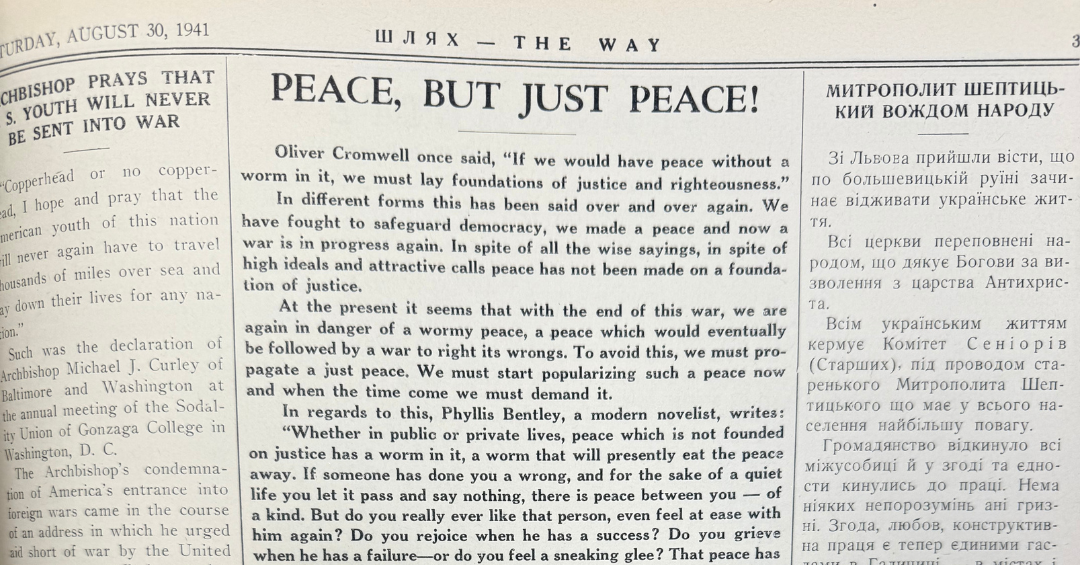
Oliver Cromwell once said, “If we would have peace without a worm in it, we must lay foundations of justice and righteousness.”
In different forms this has been said over and over again. We have fought to safeguard democracy, we made a peace and now a war is in progress again. In spite of all the wise sayings, in spite of high ideals and attractive calls peace has not been made on a foundation of justice.
At the present it seems that with the end of this war, we are again in danger of a wormy peace, a peace which would eventually be followed by a war to right its wrongs. To avoid this, we must propagate a just peace. We must start popularizing such a peace now and when the time comes we must demand it.
In regards to this, Phyllis Bentley, a modern novelist, writes: “Whether in public or private lives, peace which is not founded on justice has a worm in it, a worm that will presently eat the peace away. If someone has done you a wrong, and for the sake of a quiet life you let it pass and say nothing, there is peace between you — of a kind. But do you really ever like that person, even feel at ease with him again? Do you rejoice when he has a success? Do you grieve when he has a failure or do you feel a sneaking glee? That peace has a worm in it. And similarly when you have done someone wrong, and for the sake of a quiet life he lets it pass, do you ever feel comfortable with him again? Do you like him to be present on the happy occasions of your life, or, on the contrary, does the mere sight of him ruin the day for you? That kind of peace has a worm in it.
“The instinct for justice is one of the highest and best of all human faculties, and also one of the most widely spread. It is purely human; the animal creation seems to lack it entirely. Watch some birds quarreling over tidbits on the ground; one snatches a morsel, another snatches it away, a third will snatch it from both in his sharp beak if he gets a chance, and no bird will flap a wing to interfere. There is no law of fair play in the animal creation; no feeling that the one who has done the work is entitled to the spoils. Nature is red in tooth and claw, all right; in nature he can keep who can. The cuckoo deposits her egg in another bird’s nest and the resultant offspring kicks the other nestlings out. There is no warrant issued against the cuckoo, no judge tries her, no public posse, even, takes the law into its own hands and drives her out. Whereas the biggest human criminal on earth feels, when he sees somebody pushing out of his turn in a theater queue, that it is unjust.
“Yes, we humans have an instinct for justice. Indeed — and this is my point, as it was Cromwell’s — we can’t be happy unless justice is present.
“The past twenty years in Europe furnish perhaps the most striking example in all history of this truth. Look at the Treaty of Versailles. A wormy peace, if ever there was one! What were its results? A whole seething mass of poisonous snakes! Resentment in Germany, growing into a passionate longing of revenge which became an evil obsession; yet because there was some justice in resentment at its root, men hesitated to condemn it, and so it grew. Worms breed worms; revenge leads on to oppression again, and so again, and so again to revenge.
“It is the same in every sphere of life. International, political, economic, or private, the principle is the same. The trouble may be a world war or a political contest or a rift with a neighbor over a blaring radio. In every conflict, it is natural that one’s first desire should be to win. But even in the heat of battle we should remember also that victory is empty unless it is followed by a just and lasting peace. Peace with a worm in it leads back to war. We must realize now that, in the years to come, when this war is over, true security will lie not in guns and bombers but in justice and righteousness.”