Glory to Jesus Christ!
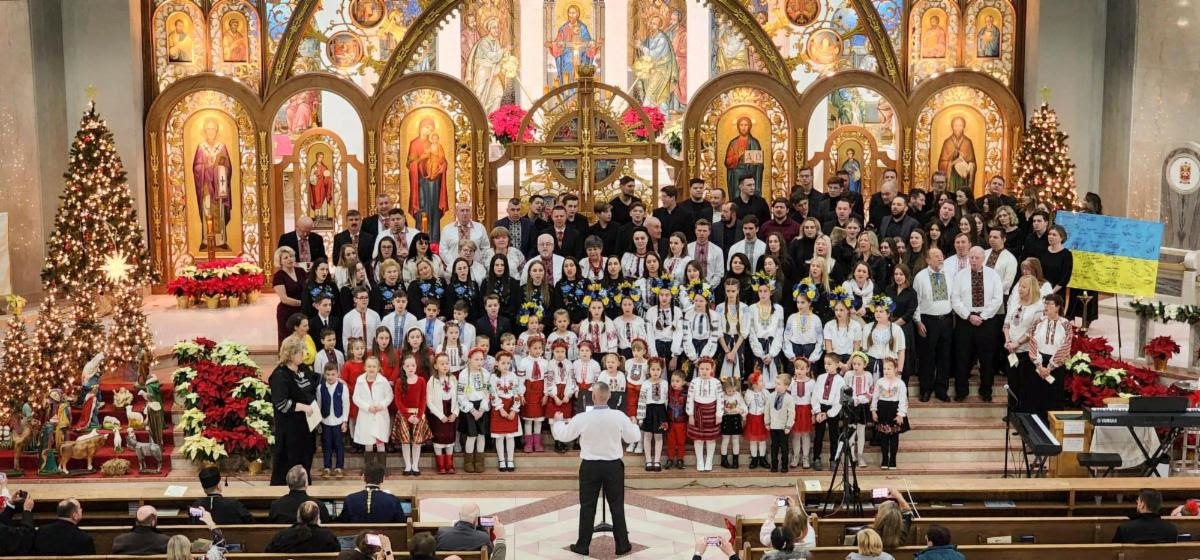
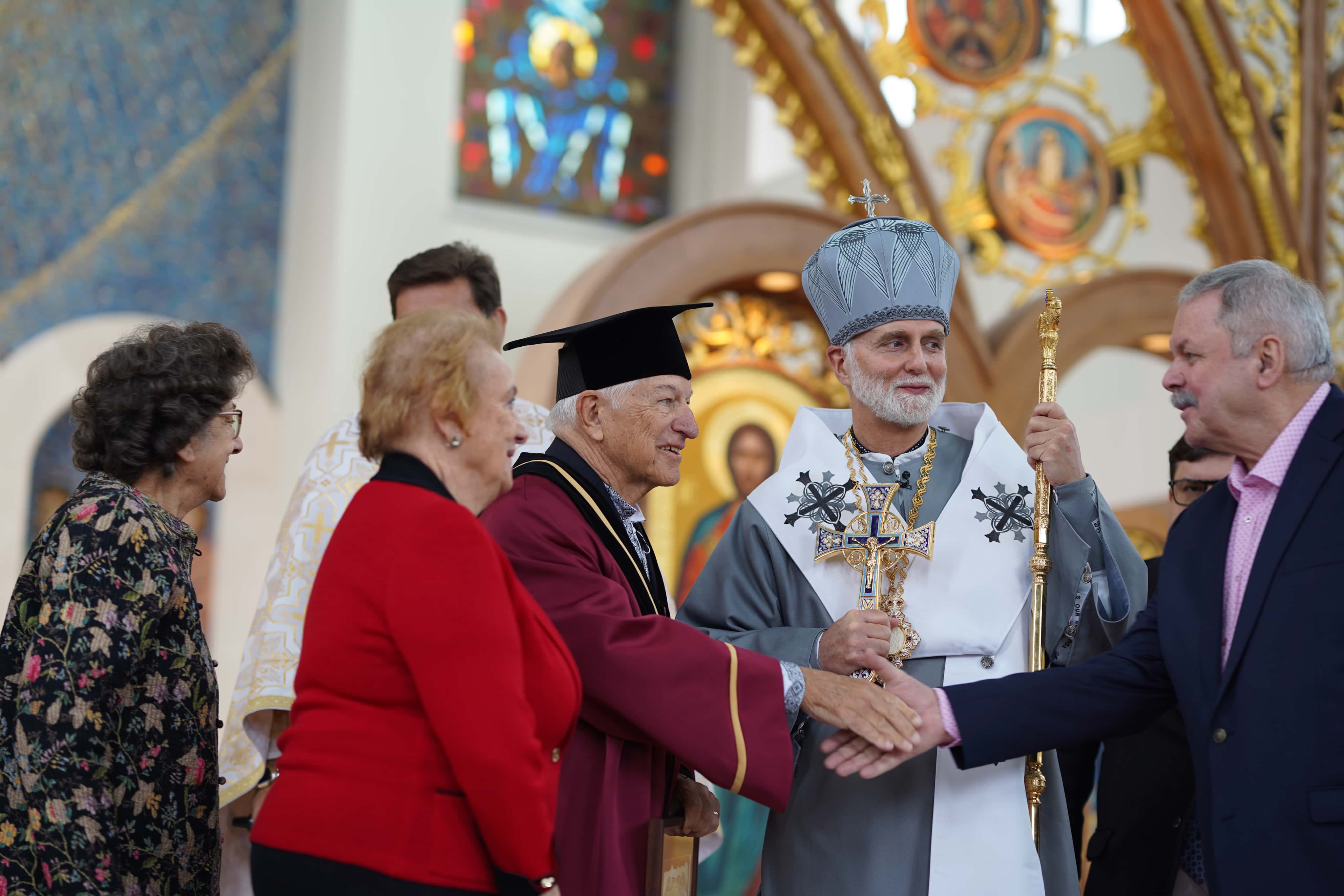
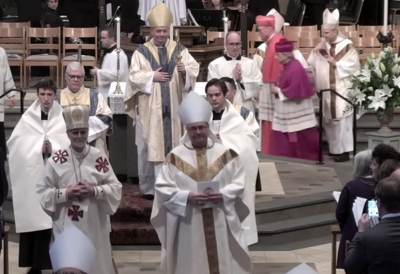
It is a joy for me to be in this church (at Saints Volodymyr & Olha Ukrainian Catholic Church in Chicago, IL) today, a place to which I first began coming almost fifty years ago. Here I have experienced many mysterious and deeply formative moments of my life.
I bring you greetings from His Beatitude Sviatoslav, who is currently in Brazil attending the sessions of the Permanent Synod, as well as greetings from all our bishops, priests, monks and nuns, from all the faithful of our Church, and from the people of Ukraine, who are sincerely grateful to you for your prayers, for your advocacy, and for spreading the truth about what is happening in Ukraine.
Today we are living through a war — not only an armed war, but also a hybrid one, with a powerful informational dimension. For this reason, I thank you for your partnership with Ukraine.
Ukraine does not need help as a poor or incapable state that has failed in its responsibilities. No. Ukraine is a stronghold of truth, of God-given dignity, of democracy, and of freedom of conscience, speech, and the press. Ukraine and her soldiers are defending truth in the world at a very high cost.
That is why your generosity, your support, and your partnership are extraordinarily important. We all face challenges — personal, family, parish, communal, and societal. Look at the challenges facing America today: the situation surrounding migrants, political tensions, and economic difficulties. I want to assure all of you who have gathered here: the Church embraces you, surrounds you with care, and stands up for you.
When I tell Americans that I am going to Ukraine again — and this has already been my fifteenth trip in the past four years, and since 2014 I believe I have been there about fifty-five times — they say to me, “How can you go there? It’s dangerous.”
And I respond, “I am going to Chicago — where nearly ten people are killed every weekend by gun violence.”
There are problems both in Ukraine and here in America.
Yet I encourage all who are able to go to Ukraine, to be as close as possible to our defenders, to the more than sixty thousand people who have lost arms or legs, to widows and orphans. This is a sign of true solidarity.
Today Ukraine has much to teach the world. And when I return from there, I cannot complain. My trip to Ukraine before Great Lent became, for me, its beginning. Because fasting and truth call us to what we heard in today’s Gospel — on Forgiveness Sunday, Cheesefare Sunday — when, according to ancient custom, having given up meat last week, those who are able now give up dairy products this week.
This Gospel calls us to difficult, yet saving actions: to forgive as our Heavenly Father forgives us; to focus on what is essential — where your treasure is, there your heart will be; and to live the ascetic discipline of fasting.
Great Lent calls us not only to restraint in food, but even more to good works, almsgiving, and prayer. What the Gospel calls us to is not merely difficult — it is impossible without God’s grace.
Take forgiveness, for example. How many parents and children, husbands and wives are unable to forgive those closest to them? They do not speak for years; they become estranged or estrange others. This is not the fault of enemies — it is human weakness. Lent calls us to forgiveness. We pray: “Our Father, forgive us our trespasses, as we forgive those who trespass against us.”
If we do not forgive, then God will forgive us as we forgive others. This is extremely difficult. Without God’s strength, it is impossible.
Perhaps someday — after decades or even a hundred years — reconciliation must come even between nations that are enemies today, as happened between France and Germany, which fought for centuries and now live in peace.
But let us begin with those who are closest.
Is there someone with whom I categorically refuse to communicate — not because of distance or lack of time, but because I have decided so?
How different our families, marriages, and relationships between parents and children would be if this Great Lent truly became a time of forgiveness.
Today, the Rite of Forgiveness will take place at Vespers. The Gospel reminds us how much God has forgiven us. God owes us nothing — yet He forgives. He has forgiven people, communities, nations, all of humanity, by giving His Son for us.
And God looks at you and at me not through the prism of our sins and weaknesses, but as His beloved children, saying, “You are My beloved son,” “You are My beloved daughter.”
Great Lent calls us to look at our neighbor with God’s eyes, to see in every person an icon of God. There is nothing more difficult than forgiveness. But God has forgiven us and says: “You, too, must forgive.”
Without grace, without prayer, without fasting, we will not manage. But these means — fasting, prayer, prostrations — help us. If you are overwhelmed by anger, make ten prostrations. Try it. You will already be thinking not about anger, but about your knees.
Let us release our wounds. Let us not nurture them. Then there will be no stone in the heart. There will be no resentment. What freedom, what strength this brings!
Let us not deny ourselves this gift. God says: “Forgive — and you will be free.”
How much we need unity today! Our young men are giving their lives, while we quarrel among ourselves. They say there are two million Ukrainians in America. Is this unity visible? Everyone has their own organization, their own competition: “I will do this better than you. We collected more than you. I am first in the photograph.”
It can be much better. Let us work toward it. This is a God-given time — here and now. In this parish. In this city. In America. We have heard the word. And we cannot say that we did not hear it or that we did not know. This word tells us that we must forgive. It is the word of our salvation. And we walk this path because we know God’s love.
Dear brothers and sisters, allow me to tell you how deeply the Lord loves you. With your sins, your weaknesses, your inner resistance, your conflicts — the Lord loves you, and He gave His life for you. For you, for me, for all of us. So that we may be with Him and with one another. So that we may love God and love our neighbor.
What a joy it is to be a Christian. Into Christ we were baptized; with Christ we were clothed. We are part of His Body, which has already ascended. Christ has risen, ascended, and taken our wounds with Him. In other words, sin has been overcome in its ultimate power. And today, at the beginning of Great Lent, we are called to join in this victory. This will be our contribution to the victory of truth in Ukraine. It will be our contribution to the victory of truth in this world.
Let us be free, light, and uplifted. Let us cast aside the stones. Let us heal our wounds, received through injustice, by our forgiveness. We know this is the only true path. If we have postponed this, if we have turned our gaze away from this priority, let us refocus and look at God’s love for us.
Where our treasure is, there our heart will be also.
Glory to Jesus Christ!