- Lenten Appeal 2026
- Strategic Resources
- Archeparchy
- Our faith
- Offices and ministries
- News and Updates
- Events
- Parishes
- Youth Protection
- Subscribe to "The Way"
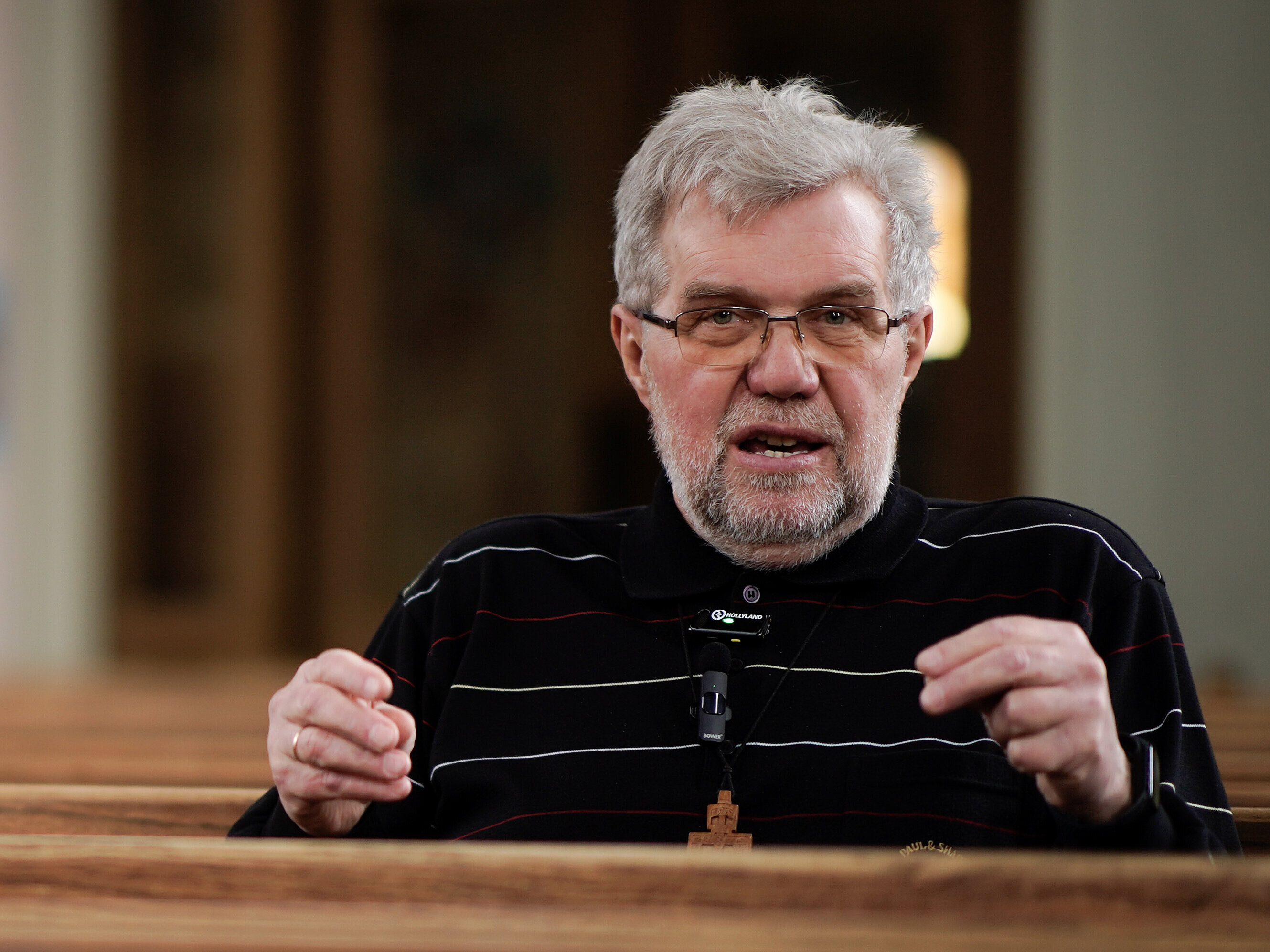
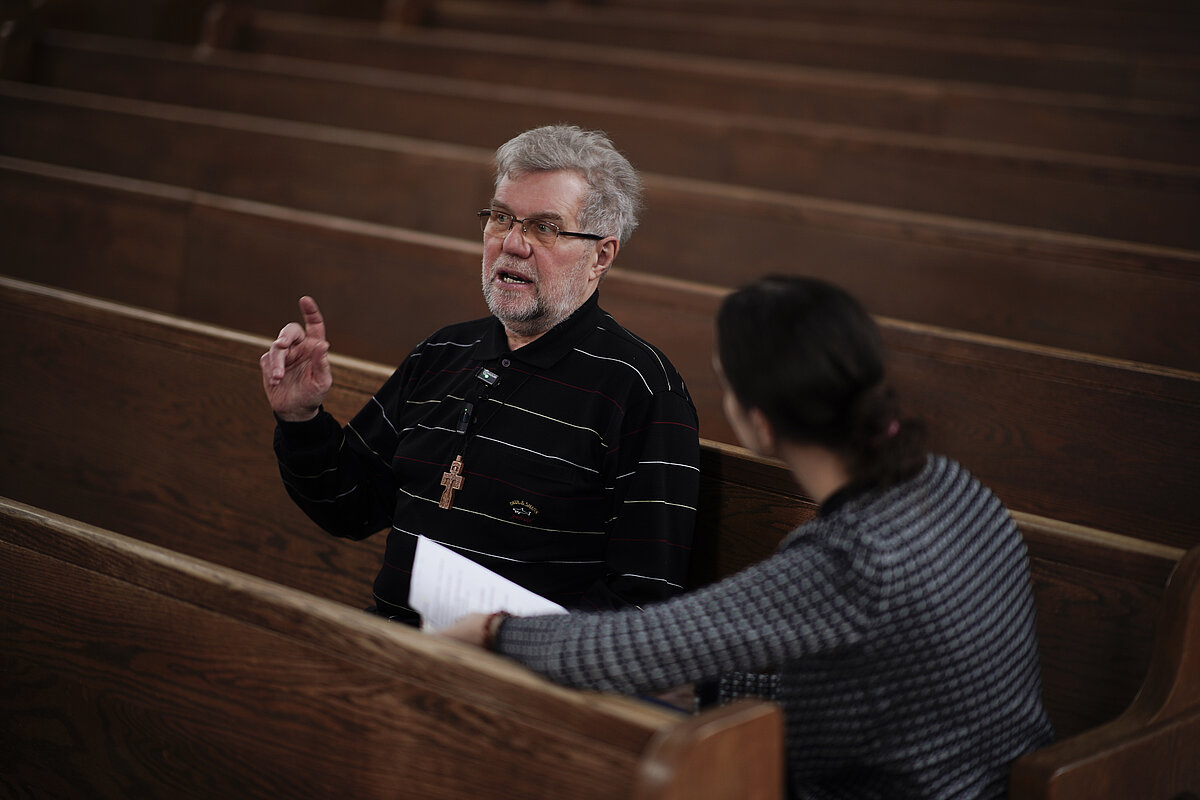
At a time of war, when daily life is marked by death, loss, and uncertainty, the message of the Resurrection may seem distant or even difficult to receive. Yet, as Fr. Mykhailo Dymyd emphasizes, it is precisely in such moments that its meaning is revealed most deeply.
Drawing on theological reflection and personal experience, the priest speaks about faith, suffering, and hope not as abstract concepts, but as a reality that Ukrainians are living through today.
— Father, how can one preach about the Resurrection of Christ in a time of war, when people are experiencing so much death and loss?
The Resurrection of Christ and war are, in fact, deeply connected themes. If we look at the Crucifixion of Jesus Christ, we see that it was a crime. It was a struggle of evil forces against good. He was not only tortured, not only crucified — He was killed.
The Gospel already contains within it the experience of violence, injustice, and war. At the same time, however, it shows that this story does not end in death — it leads into victory.
And here the essential truth is revealed: what is decisive is not the material, but the spiritual — values. Jesus Christ died for these values: for faith in God the Father, for obedience, and for love of the human person, desiring to save humanity.
When we look at the present war and at people who consciously go to the front, who accept the risk of injury, captivity, or death, we see a similar reality. They do this freely.
And that is why their sacrifice is not an end. Their life does not end with death — it continues. It takes on new strength. And that strength helps us, the living, to see a future even in darkness.
— Can we speak about resurrection on the level of a people and a country?
I think ordinary people understand very well what death is and what resurrection is. But we need to speak simply and in images they can grasp. Many people believe in God, but they do not always connect that faith with Jesus Christ. For them, God is some kind of force, something general. And here it is important to show that Jesus Christ is our God.
I often explain it like this: you venerate the Holy Shroud? Yes. Whom do you venerate? Jesus Christ. Did He die? Yes. Did He rise? Yes. So if Christ died and rose, that means we also walk this path. He did this not for Himself. He did it for us, so that we might follow His sacrifice, His death, and His Resurrection. This is especially important for young people — so that they do not simply take part in traditions, but understand their meaning.
His tone shifts in the conversation about Pascha — from explanation to witness.
— What does Pascha mean for a people living through war?
Pascha is hope. It is the future.
But this is not an abstract hope or merely beautiful words. It is a very concrete experience that people live even in the hardest circumstances — where, it would seem, there is no room for hope.
We do not simply endure. We do not merely try to survive. We live through this with an inner conviction, with a deep faith, that we will prevail. And even more than that — in a certain sense, we have already prevailed.
Because we remain free. And freedom is the key thing. When a person preserves inner freedom even in the hardest conditions, that person is not yet defeated.
There are people in the trenches who experience cold, fear, exhaustion, and danger — and at the same time feel the presence of God. And it is precisely that presence which gives them the strength not merely to endure, but to live.
This is a very particular state. It is not the kind of joy we are used to in peacetime. It is not laughter or lightness. It is a deep inner joy that is difficult to explain in words. It is born from the fact that a person is with God — even in darkness, even in suffering.
And then one’s very perception of reality changes: you are no longer merely a victim of circumstances — you become a participant in something greater. You are with Christ in this struggle. And that is why Pascha becomes not only a feast, but an experience — the experience of life stronger than death.
This is the beginning of victory. It is an inner victory that, in time, becomes an outward one.
— How has the war changed people, their faith, and their attitude toward life?
It depends very much on the person. War does not make everyone the same — rather, it reveals what is already inside.
There are people whose faith has grown stronger because of the war. They began to pray more, to seek God more, to trust Him more deeply. For them, the war became a moment of deeper conversion.
There are others who did not have faith and did not find it even in these circumstances. They live through this reality, they struggle, but they do not connect it with God. There are also those who have begun to doubt. They ask very painful questions: “God, why did You allow this?”
And these questions are honest. But here it is important to understand this: God created us free. And that freedom means that a person can choose both good and evil.
At the same time, Christ is not distant from this reality. He is near. He is in the trenches. He is with those who are freezing, hungry, wounded, and exhausted.
And even if a person does not feel that, it does not mean that God is not there. Sometimes God is closest precisely when it seems that He is absent.
— Do you see spiritual changes in society since the beginning of the full-scale war?
At the beginning of the war, many people came to the Church. People prayed and sought God. Over time, that visible fervor diminished somewhat. But that does not mean faith disappeared. There are people who no longer pray aloud. Yet deep in their hearts there remains a turning toward God — an expectation, a dialogue, even without words. I believe this, too, is a form of piety.
Many people continue to seek God, even if they cannot clearly name Him.
— How does war change the understanding of suffering and hope?
There are different responses. There are people who associate suffering with hatred and a desire for revenge. They rely on force, on weapons. And there are others who also experience pain, but do not allow that pain to turn into hatred. They still see a human being even in the enemy. But at the same time, they understand that they must defend life.
So they fight — but not against the person as such; rather, against the evil that brings death.
— What impresses you most in people’s behavior during the war?
I am impressed by resilience, sacrifice, and hope. But especially by gratitude. Gratitude to previous generations who fought even when there was no hope of seeing victory in their own lifetime.
We are beginning to understand that our struggle did not begin with us. And that God has guided us through history. And when a person realizes this, he or she finds the strength to keep going.
— What is the role of the Church during war? What do people seek most in it?
The Church must give people hope.
It must remind them that God is present, that He is in our life, in our body, in our suffering. That He suffers with us. And that He calls us to the Resurrection. Love for God must be practical — expressed in love for one’s neighbor.
Today, that neighbor is the one who suffers. And the Church must help that person in many different ways.
As the conversation turns to loss, his words become especially personal.
— How can priests accompany people who have experienced loss or trauma?
It is a very difficult task. And I would say more than that — it is a task that exceeds human strength. Even a priest remains a human being who also experiences pain and can also become exhausted, especially when he encounters the suffering of others every day.
I will speak from my own experience. When my son was killed, many people wanted to support me. They called, wrote, came, wanted to say something, to somehow ease that pain.
And that was sincere. It mattered. But one moment affected me more than anything else.
A bishop Hlib Lonchyna called me. He was far away, in Paris. And he could not say anything. He simply fell silent… and began to cry. And that was the strongest thing.
Because in that moment I understood: words cannot fill that wound. It is not just pain. It is something much deeper. It is, one might say, as though a hole appears within a person. The body remains, life goes on, yet there is this wound that runs through one’s whole being.
And no words can close it.
That is why the most important thing is presence. Quiet, gentle, not intrusive. Without trying to explain everything, without ready-made answers. Not “I know what to say,” but “I am with you.”
It can be silence. It can be a look. It can be a tear. It can simply be staying near.
Of course, there are also concrete things the Church does and must do: prayer — Divine Liturgies, memorial services, panakhydas; remembrance — when the names of the fallen are spoken in church. But all of this requires great sensitivity.
Because every person experiences loss differently. And a priest must sense when to speak and when to remain silent. And perhaps most importantly, one must not be afraid of another person’s pain. One must remain near.
Because it is often precisely in that presence that the presence of God is revealed.
— Has the ministry of a priest changed during the war?
Yes, but its essence remains the same. A priest must preach Christ. And Christ does not preach war — He is a peacemaker.
We live in war, but we cannot lose God’s law of love. We must ask ourselves: what would Christ do in my place?
We must see the image of God in every person — even in the enemy.
This does not mean we do not defend ourselves. We do defend ourselves. But we must not allow hatred to destroy us from within. For example, I do not hate those who killed my son. And people are surprised by that.
But I want to remain a person of light.
— What helps a person not lose hope in a long war?
Our hope is not based on our own strength or on weapons. It is based on God. And that is why it is so important to turn to Him every day.
Even a short prayer is already a connection to the source of hope. Community is also very important — family, friends, people who support one another. When we help one another, we restore hope.
Toward the end of the conversation, he speaks directly to those who are exhausted and feel they have no strength left.
— What would you say to those who feel they have no strength left?
I would embrace such people. And I would say that it is normal to feel that way — to have no strength left. Because if a person is living through loss, fear, and exhaustion, that is natural. I understand them. And I will say honestly: if I were not a believer, I too would have no strength. But I believe that God gives strength. And I do not always know where it comes from — but it is there.
For us, the example of Christ is important. During His Passion, He was powerless. He was humiliated, beaten, crucified — and He did not resist by force. And this shows that even in powerlessness there is meaning. So one should not immediately look for great solutions.
Take one small step. Just one. Say a kind word. Call someone. Extend a hand to help.
And that small step already begins to change the situation. Because strength comes not from us, but from God.
— What is the main word you would like to say to Ukrainians today?
Gratitude.
We belong to a great people. And in this people there is a place for everyone.
Everyone is part of this struggle.
If you are at the front — you are fighting.
If you are in the diaspora — you are speaking the truth.
If you are helping — you are supporting.
If you simply go on living and do not give up — you are already part of this front.
And so — gratitude.
Gratitude to God.
Gratitude to people.
Gratitude to those who came before us and to those who stand beside us today.
This is what gives us the strength not to stop — and to keep going, despite everything.
His words leave behind a simple yet profound call: to live with hope even when it seems impossible.
Interview and text by Oksana Loziak