- Strategic Resources
- Archeparchy
- Our faith
- Offices and ministries
- News and Updates
- Events
- Parishes
- Youth Protection
- Subscribe to "The Way"
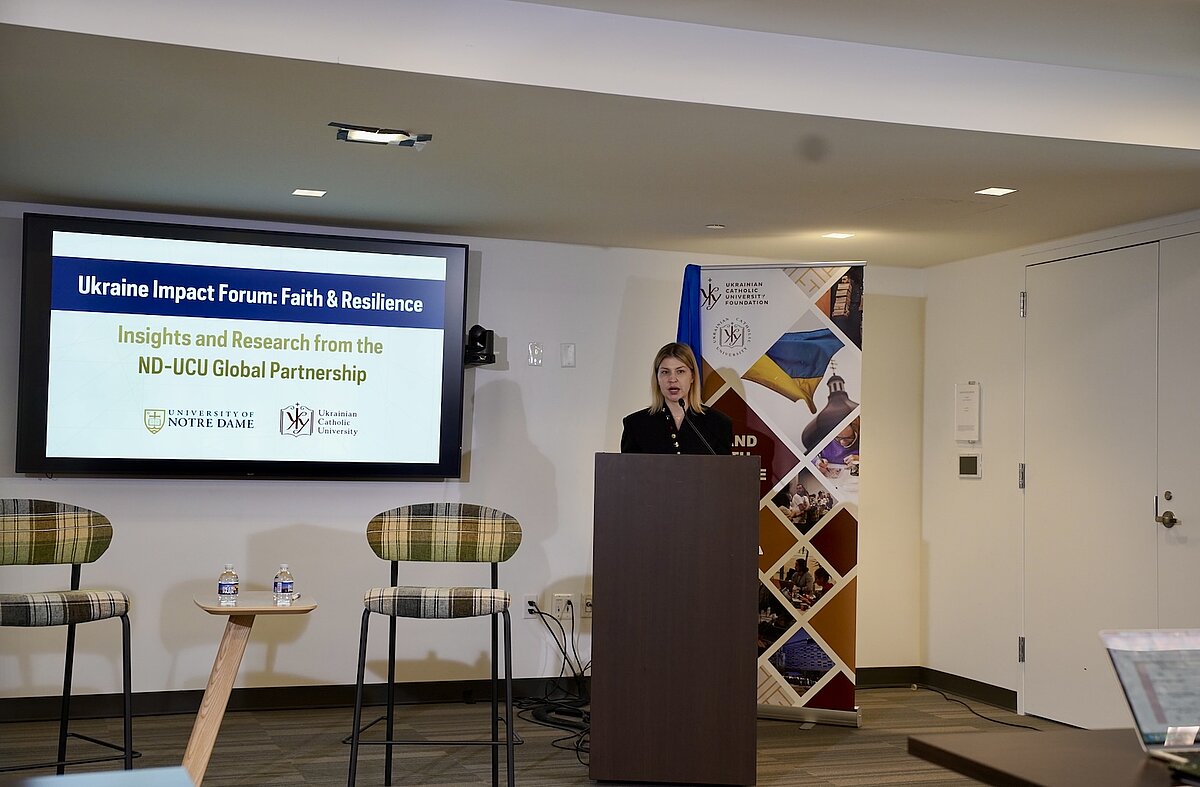
Representatives of the Ukrainian Catholic Archeparchy of Philadelphia attended the Ukraine Impact Forum: Faith & Resilience on April 20 at the University of Notre Dame DC campus. The event was jointly organized by the University of Notre Dame and the Ukrainian Catholic University.
The forum opened with a moment of silent prayer.
Archbishop Borys Gudziak joined a fireside conversation on the partnership between the University of Notre Dame and Ukrainian Catholic University, and the role of academic institutions amid Russia's war against Ukraine. The session was moderated by Mary Gallagher, Dean and Professor of Global Affairs at the Keough School of Global Affairs.
In his opening remarks, the metropolitan expressed gratitude to the University of Notre Dame for the long-standing collaboration, noting that it is deeply personal while also operating at the highest level of competence, combining both research and fellowship.
Reflecting on the responsibility of universities in wartime, Archbishop Gudziak posed a pointed question: "What can universities do when there is a war that is explicitly genocidal?" He emphasized that heart-to-heart relations carry profound meaning in such moments, offering the resilience needed to endure — "That gives you the resilience to stand up to war."
On the identity and mission of Catholic institutions, he spoke of the call to encounter each person fully — "somebody that has a soul, has a history, has a culture, has a destiny."
He closed with an appeal for solidarity and concrete action: "You never make a mistake when you help somebody in need. Today, Ukraine needs your solidarity."
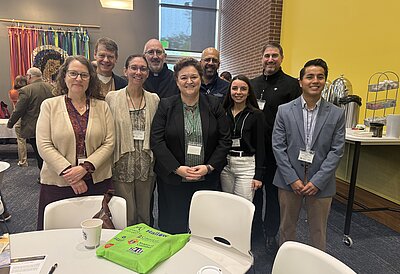
The forum brought together representatives of the University of Notre Dame, Ukrainian Catholic University, U.S. government institutions, educators, advocates, and broader academic and policy community.
The forum brought together voices across a range of sessions: Sofia Opatska and Rory Finnin opened with introductory remarks, followed by Rahul Oka and Iryna Semkiv on collective trauma and community-based healing in Ukraine; Clemens Sedmak and Volodymyr Turchynovskyy on a moral biography of Ukraine; Nitesh Chawla and Yaroslav Prytula on AI, data, and innovation during the war; Yury Avvakumov and Anatolii Babynskyi on religion, religious diplomacy, and Russia's invasion of Ukraine; Julie Turner on protecting children and faith-based leadership in Ukraine; and Naz Durakoğlu and Tyler Brace in a discussion with the U.S. Senate Foreign Relations Committee.
The forum also heard from Ambassador of Ukraine to the United States Olga Stefanishyna, who underscored the vital role of academic and international support for Ukraine. "Your voices and support through scholarship are vital — they ensure that Ukraine is understood, that knowledge grows, and that Ukraine is heard," she said, adding that "we represent a country that is still standing because brave Ukrainians are keeping the front and keeping the country running."
She further spoke to the power of academic and faith-based collaboration in strengthening international understanding, pointing to such partnerships as a force for "restoring truth, growing knowledge, and defeating evil" — and called for continued engagement as essential to sustaining support for Ukraine.
The program also included a research showcase presenting joint initiatives of the collaboration between two universities
The event concluded with a reception and final remarks by Archbishop Gudziak.
Archbishop Borys Gudziak honored the memory of students and members of the Ukrainian Catholic University community who lost their lives in Russia's war against Ukraine. He named thirty-eight members of the university community who gave their lives, sharing their stories not "to provoke emotion," but because "when I look at them, I see… lives that were complete."
The metropolitan addressed the nature of the war directly: "It was not God's will that they were killed. Evil is real. War is real." He described the conflict as one that "begins with a lie, moves to violence, and… can become genocidal."
He closed by calling on those present to remain engaged: "Ukraine stands… and your solidarity with them is crucial."