- Archeparchy
- Our faith
- Offices and ministries
- News and Updates
- Events
- Parishes
- Youth Protection
- Subscribe to "The Way"
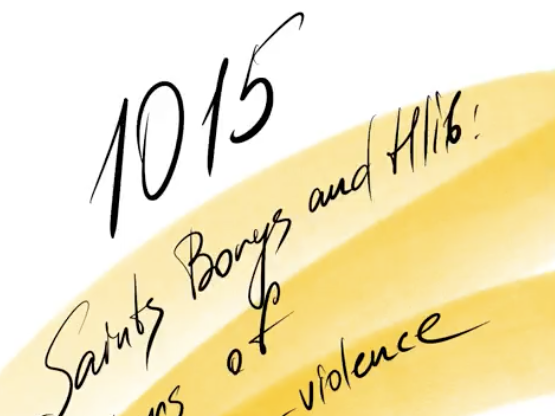
After the death of Grand Prince Volodymyr the Great in 1015, the ruler who baptized Kyivan Rus’, a struggle for power broke out among his sons. Kyiv was the center of a large state made up of many principalities, each ruled by its own prince, while the Grand Prince governed from Kyiv.
One son, Sviatopolk, tried to seize control of Kyiv by force and rule the land through violence and fear. Two of Volodymyr’s younger sons, Borys and Hlib, chose a radically different path. Almost a thousand years before leaders like Mahatma Gandhi, Martin Luther King Jr., and Nelson Mandela, they responded to injustice with non-violence.
Borys told his older brother: “In the place of our father, you will be our father.” He refused to raise a sword against him. Sviatopolk, driven by hunger for power, attacked Borys, who accepted death rather than fight his own brother. Soon after, Hlib made the same choice.
Borys and Hlib became martyrs not only for their Christian faith, but for love, fraternity, peace, and reconciliation within family and society. They were canonized about fifty years after their deaths and became powerful symbols of forgiveness. Their witness follows the example of Christ, who accepted suffering out of love for humanity. In today’s world, where violence and war continue to grow, their message remains prophetic and urgent.
Keys:
The conflict began after the death of Saint Volodymyr in 1015.
Sviatopolk sought power through violence.
Borys and Hlib chose non-violence and brotherly love instead of war.
They died not only for faith, but for peace and unity.
They were among the first saints of Kyivan Rus’.
Their example anticipates modern movements of non-violent resistance.
Dynastic struggle – conflict between members of the same ruling family
Martyr – someone who dies for faith or moral conviction
Non-violence – refusing to use force, even in the face of evil
Canonization – recognition by the Church that a person is a saint
Reconciliation – restoring peace and broken relationships