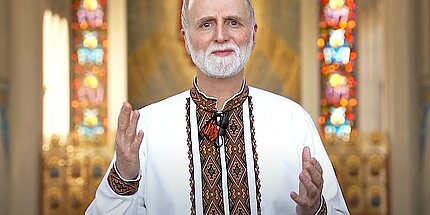
The Lord Calls Us to Mercy: Homily of Archbishop Borys Gudziak on the 25th Sunday After the Descent of the Holy Spirit

Today’s parable — the Parable of the Good Samaritan — is one of the most well-known. It reveals the radical nature of God’s word and the coming of Jesus, for whom we prepare in this pre-Christmas fast.

Jesus is coming; Jesus is moving. And this parable is a parable of movement.

The man who was robbed and beaten — from where was he coming and where was he going? He was walking from Jerusalem to Jericho. Jerusalem is in the center of Israel, situated on high ground. Jericho is south and below Jerusalem, toward the Dead Sea. This route through the desert is desolate territory. Even today, few live there. You can see Bedouins, which means “desert-dwellers” camped out by the roadside. It is a long road from Jerusalem to Jericho.

On this road, bandits attacked a man. They beat him and left him almost dead. Along the same road, the very same path, first comes a priest — perhaps not in full vestments, but bearing certain visible signs of his ministry. Then came a Levite, a person of priestly lineage. Both ignore the injured man. Both pass him by. The parable says explicitly: “he passed by.”

But after them comes a Samaritan. For the Jews, Samaritans were impure, foreigners — people with whom one could not have contact. And it is precisely this Samaritan who takes the man, carries him, brings him to an inn. He cleans his wounds with oil and wine, leaves money — two denarii, a significant amount, equivalent to two days’ pay, let us say in today’s terms 400 dollars — and says to the innkeeper: “If you spend more on him, I will repay you when I return.”

The Samaritan — the one the Jews rejected, considered impure, someone they would not touch — he is the one who saves. One might argue that the priests thought the beaten man was dead, and that a dead body was impure, not to be touched. If they had been going to Jerusalem, it might have been an excuse — they had to preserve ritual purity. But they were returning from Jerusalem, where they had prayed and been spiritually renewed after their pilgrimage. And still they ignored the unfortunate man. But the Samaritan helped him. He saved him.

Dear brothers and sisters, this parable is for us. Our neighbor is the one who is nearby. Pope Francis explains this in his encyclical Fratelli tutti: there is a theory that I must first take care of my family, then my friends, then my neighbors, then those who speak my language and belong to my Church, and only afterward think about Latin Americans, African Americans, Muslims. But Jesus says: No. Do you want to know who your neighbor is? It is the one standing or lying before you. The one at your feet. Jesus breaks the categories that were in the minds of the priest, the Levite, and the whole chosen people.

That Jesus acts as an Israelite, that God’s will is fulfilled through this chosen people, which it is, does not mean that all others are second-class peoples or second-class human beings.

And we, as a Church and as a people, need to break out of our bubble. Yes, we are at war. Everyone must know about our war. That is true. And we must do everything possible so that they know about it. But do we know how people in Sudan are suffering? Do we know that in Mexico more people have been killed in drug cartel wars than in Ukraine during the Anti-Terrorist Operation (the 2014–2022 war prior to the full-scale invasion)? Today there are 50 ongoing conflicts in the world. How can we expect someone else to help us if we consider others “impure,” untouchable? For us are Black people, Muslims, Spanish-speaking people “foreign.” Do we say that “they” should deal with “their own problems”? This is the attitude of the Levite. This is the attitude of the priest. But it is not the attitude of the Samaritan, whose very name now means “one who does good.”

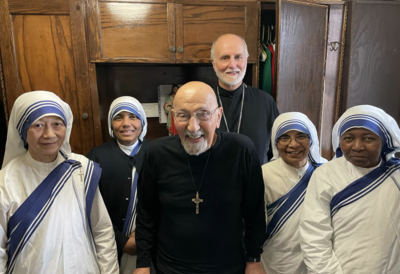
In our Archeparchy we have the Good Samaritan Pantry, founded by Sister Theodora Komyn. Our refugees are served there. Every week new deliveries of food and clothing arrive for those in need. Do you know who our people are? All who are in need. Among them are Ukrainian refugees, but also Chinese people come, African Americans come, people of many backgrounds. And it is not enough to say, “If you come, we will help you.” We must go to them.

Every Tuesday Sister Theodora, together with about one hundred volunteers — some from our parish, some from our Church, and many from outside it — prepare and distribute two hundred meals with sandwiches and water to people on the streets: the poor, the destitute, and those struggling with addiction.

The war has awakened in us a desire to help. This is good and necessary. And we must strengthen this desire, because we see that the harm, destruction, and persecution of the Ukrainian people are worsening. But we must have wide-open criteria of love. We must be merciful.

In this radical parable — and the Gospel of Luke contains some of the most radical parables: this one and the parable of the Prodigal Son — Jesus insists on mercy. The verb used to describe the mercy of the Samaritan is “splagchnizomai.” It denotes the highest degree of mercy. In the Gospel of Luke it is used only three times: in this parable, in the parable of the Prodigal Son, and in the story of the raising of the widow’s son.

Jesus, gives an answer to our question: “How should I live? What should I do? How should I love? Whom should I love? Who is my neighbor?” By offering this parable, our Lord emphasizes that we must live mercifully. And the verb splagchnizomai means to the highest degree of mercy.

The Lord calls us to mercy.

We have experienced this mercy in a new way during the war. So many good people support us.

Two weeks ago, I was at the conference of American bishops. And at every encounter, the first thing I heard is: “We are praying for you.” When we drive through Washington, it is striking to see how many Ukrainian flags are still visible! Let us think: when have we, Ukrainians, placed in front of our homes the flag of a country that is suffering? And yet we rejoice when someone else does it. And Jesus says: “Go and do likewise.” Show radical mercy. Not only to your own who are far away, but to all who are near.

There is no middle road. We either do this, or we wither spiritually. What a beautiful example we have in Sister Theodora and our volunteers. Two years ago, the Good Samaritan Pantry — along with charitable projects of the Basilian Sisters in America and in Zaporizhzhia — was recognized by Catholic Extension as an exemplary ministry in the Catholic Church in America. We have an outstanding example in our community that should inspire us.

Let us look at the sacrifice of our soldiers, our defenders. At the sacrifice of medics, priests, chaplains, those on the front lines, those who help tirelessly. Let us listen to the parable of the Good Samaritan and make use of this time of pilgrimage toward the Nativity of Christ. We are walking — whether from Jerusalem or to Jericho, or toward our own Jerusalem. Let us open our hearts so that the level of mercy expressed in the verb “splagchnizomai” may inspire us and lift us up. For only in such a life is our true happiness. Only in such a life is our true peace.

Glory to Jesus Christ!

Related News

More News
Clergy and Faithful Gather for Thanksgiving Divine Liturgy Honoring Metropolitan Borys Gudziak’s 65th Birthday

#Archeparchy

Clergy and Faithful Gather for Thanksgiving Divine Liturgy Honoring Metropolitan Borys Gudziak’s 65th Birthday

«Жити свято»: розмова з митрополитом Борисом про війну, покликання й мир у серці

#Interview

#U.S.

#Ukraine

#Archeparchy

«Жити свято»: розмова з митрополитом Борисом про війну, покликання й мир у серці

Church, Diplomats, and Lawmakers Join in Prayer for Ukraine at Capitol Hill Mass

#U.S.

#Ukraine

#Archeparchy

Church, Diplomats, and Lawmakers Join in Prayer for Ukraine at Capitol Hill Mass

Metropolitan Borys Gudziak Speaks at King’s College in Pennsylvania on Peace and War in Ukraine

#U.S.

#Archeparchy

Metropolitan Borys Gudziak Speaks at King’s College in Pennsylvania on Peace and War in Ukraine