- Christmas Appeal 2025
- Archeparchy
- Our faith
- Offices and ministries
- News
- Events
- Parishes
- Youth Protection
On January 6 we celebrate the Feast of Theophany—one of the twelve great feasts of the liturgical year. At the heart of this celebration is the baptism of Jesus Christ in the River Jordan. It is here that God reveals Himself to the world—hence the name Theophany, the manifestation of God: the voice of the Father is heard, the Son stands in the waters of the Jordan, and the Holy Spirit descends in the form of a dove. Theophany is the feast of God’s presence—of a God who does not remain distant, but enters the very depths of human existence: into the waters of the Jordan where sinners stepped, into the reality in which we ourselves live.
At first glance, this event may seem surprising. Jesus, the sinless Son of God, stands in line with sinners before John. Yet for Him this is not an act of repentance, but an act of love and solidarity. Christ enters the waters of the Jordan not for His own sake, but for ours. He descends into the depths of human history—into its chaos, pain, and brokenness—to begin the path of salvation. Christian tradition often sees in this descent an already paschal dimension: the beginning of the journey that will lead to the Cross and the Resurrection.
Why water?
In biblical revelation, water is the primordial setting of God’s action in creation and salvation. At the beginning of the Book of Genesis, the Spirit of God hovers over the waters, initiating creation. Water becomes the place where God brings order, purification, and a new beginning: in the Flood it both judges sin and preserves life; in the crossing of the Red Sea it becomes the boundary between slavery and freedom; in the desert, water from the rock reveals a God who sustains life when human resources are exhausted.
In the New Testament, the symbolism of water becomes even deeper. Jesus walks on water, revealing His authority over chaos and fear. From the cross He asks for water, sharing to the very end in human thirst—not only physical, but spiritual. And in the Jordan, the Son of God enters the water to sanctify it and, through it, all creation. As the Fathers of the Church teach, Christ is not cleansed by the water; rather, the water is cleansed by His presence. From that moment on, water becomes a bearer of grace, through which, in Baptism, a person dies to the old life and rises to a new one, entering the paschal mystery of Christ.
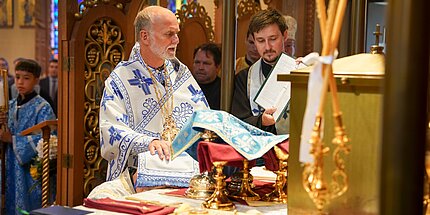
For this reason, in our tradition the blessing of water on the Feast of Theophany carries profound meaning. We bless water in the church, sanctify our homes, and keep this water not as a magical talisman, but as a sign of God’s nearness and the power of His grace. Touching this water, we recall our own baptism and are called each day to allow God to enter the “waters” of our lives—to cleanse, heal, and renew us.