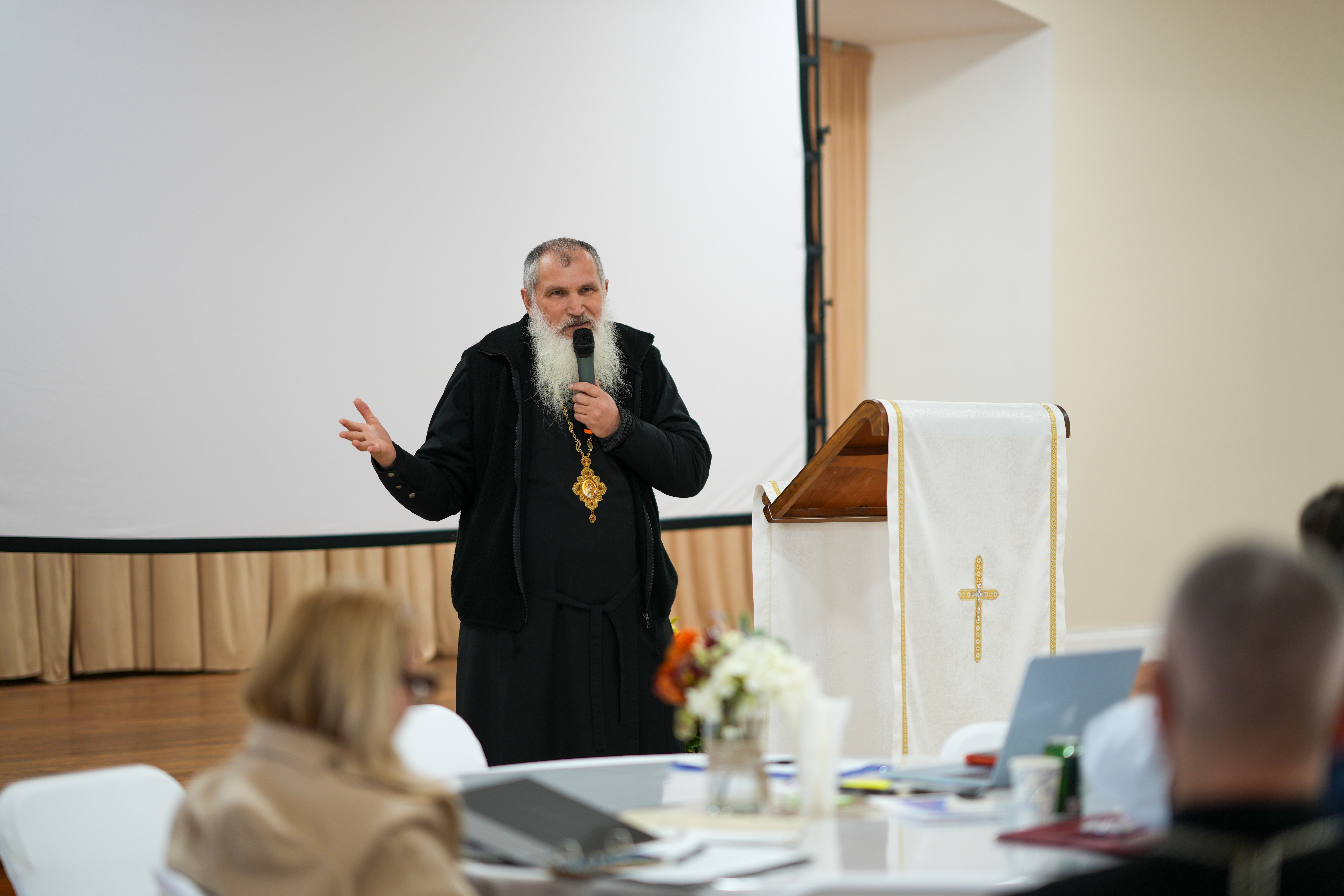
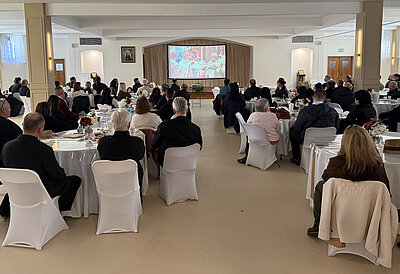
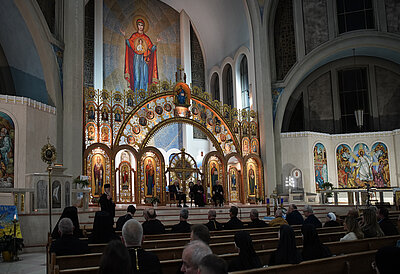
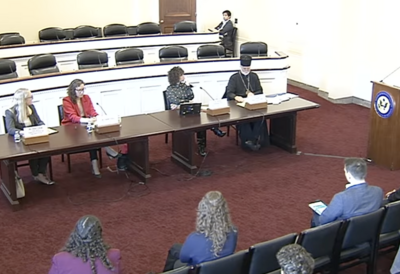
On November 20, 2026, during the Strategic Planning Session of the Ukrainian Catholic Archeparchy of Philadelphia, Bishop Benedict Aleksiychuk of the Ukrainian Catholic Eparchy of St. Nicholas in Chicago addressed participants with reflections on vocations and the importance of recognizing God's purpose for each person's life.
In his remarks, Bishop Benedict emphasized that today's crisis of vocations extends beyond priestly and religious life to a deeper challenge: the difficulty many people face in understanding their own calling. He stressed that discerning one's vocation begins with a personal relationship with God, prayer and a willingness to respond to His call.
We invite you to read the full text of Bishop Benedict Aleksiychuk's address.
Glory to Jesus Christ!
Dear Bishop, Reverend Fathers, my dear brothers and sisters in our Lord Jesus Christ!
It is a pleasure to be with you.
Today, one of the topics you will be discussing is vocations.
I believe this is the most important thing in life: to discover God's will and fulfill it.
We have only one life, and it is important to make the best possible use of it.
Whenever we talk about vocations in the Church today, we most often hear about a crisis in priestly and religious vocations. That is why we pray for vocations and look for new ways to promote and encourage them. All of this is certainly important and necessary.
However, I am convinced that we are facing not simply a crisis of priestly and religious vocations, but something much deeper: a general crisis of people understanding their purpose in life. This is a far more fundamental problem. We have only one life, and we should strive to live it to the fullest.
Everything has its purpose.
Everything is meant to serve something.
The same is true of us.
There are no special VIPs.
Each of us is special and unique.
We need to discover what makes us unique.
Statistics suggest that 70 percent of people experience feelings of inferiority.
If we went out onto the streets today—in Philadelphia, Lviv, or any other city—and asked ten random people, "What is your calling? Why do you live? What is your purpose in life?" I am more than convinced that nine out of ten would not be able to give a clear answer.
That is sad.
Of course, they might tell us about their profession, work, family, children, or other responsibilities. Someone might say, "I am a doctor." Another might say, "I am a teacher." Someone else might say, "I am a father" or "I am a mother."
But a profession is not necessarily a vocation. A person can live an entire life without ever seriously reflecting on what God is calling them to do.
If I asked each of you to name your five biggest weaknesses, I think you could probably do it, even if it took a little effort.
But what if I asked you to name your five greatest strengths—the talents, abilities, and gifts God has given you? Would that be just as easy?
A person can spend an entire lifetime doing all kinds of things, taking on different responsibilities, and fulfilling various roles, yet never discover their true calling.
I can say with certainty that it is impossible to discover our vocation without coming to know the One who calls us.
We often speak about the saints. We remember their asceticism, extraordinary deeds, sacrifices, hard work, and perseverance. But are we perhaps overlooking what matters most?
Above all, the saints were people who lived in the Lord. In our prayers, we address God as the One who dwells in His saints. Their holiness grew out of their deep relationship with God.
They did not simply do things for God—they lived with God.
As we draw closer to God, we gradually come to understand ourselves better. We begin to see our lives not simply in terms of our own desires, ambitions, or fears, but in light of God's plan for us.
First, we need to draw closer to the Lord, learn to spend time in His presence, and build a personal relationship with Him. Then, little by little, we begin to discover what He is calling us to do.
That is why the question of vocation is, first and foremost, about our relationship with God.
Our vocation always goes beyond ourselves.
The example of the Mother of God.
We have stereotypes about ourselves and others.
All problems are in our minds; all solutions are in the Lord.
This reminds me of the Gospel story of Martha and Mary (Luke 10:38–42).
Martha welcomes Jesus into her home. She is busy preparing, organizing, and taking care of everything necessary. She wants to offer the Lord the best possible hospitality.
Mary, however, sits at the feet of Jesus and listens to His word.
Notice that Martha's problem was not that she was working. Her service was also necessary. The problem was that, in the midst of all her busyness, she lost sight of what mattered most—the opportunity to be with the Lord and listen to Him.
I think this Gospel story really speaks to our life as a Church. We are always busy organizing things. We plan events, form committees, hold meetings, develop strategic plans, look for new ways to evangelize, and create pastoral programs.
But this raises an important question: In the midst of all our plans and activities, are we forgetting what matters most? Do we make time simply to be with the Lord? Do we sometimes get so caught up in doing God's work that we forget to spend time with God Himself?
Therefore, when we speak about vocations, I would like to invite each of us to ask ourselves a few very simple but serious questions.
How much time do I devote to prayer?
Do I set aside time each day for a personal encounter with God?
How often do I read Sacred Scripture, not simply to gain information, but to hear what the Lord is saying to me personally?
How often do I approach the Sacrament of Reconciliation?
Do I participate consciously in the Eucharist?
Do I understand that, in the Divine Liturgy, I encounter the living Christ, who gives Himself to me?
Do I work on my weaknesses and on those things that distance me from God and from other people?
As we continue to grow spiritually, learn to listen to the Lord, and become more attentive to His presence, we gradually begin to understand what He is calling us to do.
Discerning our vocation does not happen overnight. It takes time, prayer, spiritual guidance, life experience, and an openness to change.
As I approach the conclusion, I would like to turn to another Gospel story—the parable of the Good Samaritan (Luke 10:25–37).
We know this story well.
A man falls into the hands of robbers, who beat him and leave him by the roadside. A priest and a Levite pass by. They see the wounded man but continue on their way.
The Samaritan, however, stops. He approaches the man, bandages his wounds, places him on his own animal, takes him to an inn, and cares for him.
Why do I mention this parable in the context of vocation?
Because the Good Samaritan did more than simply perform a good deed.
He saw a particular person, recognized his need, and accepted the responsibility that arose before him at that moment.
He did not pass by.
Perhaps he did not have a carefully developed strategy for helping wounded people. But he was inwardly prepared to recognize another person's need and respond to it.
It was precisely in that encounter that his vocation became visible.
This is a very important dimension of the Christian vocation.
God calls us not only to a particular way of life. He calls us to holiness, to love, and to serve the people He places in our lives. The Good Samaritan understood that, at that very moment, he was called to be a neighbor to the man who had been wounded. That, too, is a vocation.
If we want to see more priestly and religious vocations, we need to do more than reach out to potential candidates for seminaries and religious communities. We need to create an environment in which people learn to recognize their own calling.
A parish should be a place where people do more than just attend services. It should be a place where they gradually discover who they are in God's eyes, what gifts He has given them, and how they can use those gifts to serve others.
Parents should help their children not only choose a future profession, but also ask a deeper question: What is God calling you to do? How can you use your gifts to serve others?
Priests should be not only organizers of parish life, but also spiritual guides who help people discern God's will.
And laypeople should recognize that their vocation is not secondary or less important than priestly or religious ministry.
As I conclude, I would like to return to the simple question with which we began:
Addressing the crisis of vocations takes more than developing new programs, strategies, or organizational plans. It starts with a person who encounters the Lord, learns to live in His presence, and becomes able to hear His voice. We cannot discover our vocation without knowing the One who calls us.
Therefore, our primary task is to grow in the Lord.
To be with Him in prayer, to listen to Him in Sacred Scripture, to encounter Him in the Eucharist, and to purify our hearts in the Sacrament of Reconciliation.
Only then will we be able not merely to speak about vocations, but to help people discover, embrace, and fulfill their calling.