- Fundraisers 2026
- Archeparchy
- Our faith
- Offices and ministries
- News and Updates
- Events
- Parishes
- Child Protection
- Ways to Give
- Subscribe to "The Way"
Dear Readers,
As we explored the archives of The Way, we rediscovered a treasure of editorials that spoke to the hopes, challenges, and aspirations of our Church and community. Though written decades ago, many of these reflections remain surprisingly relevant today.
We are pleased to launch Blast from the Past, a new series featuring selected editorials from past issues of The Way. We begin with the year 1941, inviting you to journey back in time and rediscover the thoughts, values, and conversations that shaped our community more than eighty years ago.
Some articles may inspire, some may challenge, and others may offer a fascinating glimpse into the concerns and priorities of a different era. Together, they remind us of the enduring mission of The Way and the rich history of our Church.
We hope you will find these historical voices meaningful, enlightening, and worthy of renewed attention.
Sincerely,
The Editorial Team
Originally published in The Way on April 26, 1941.
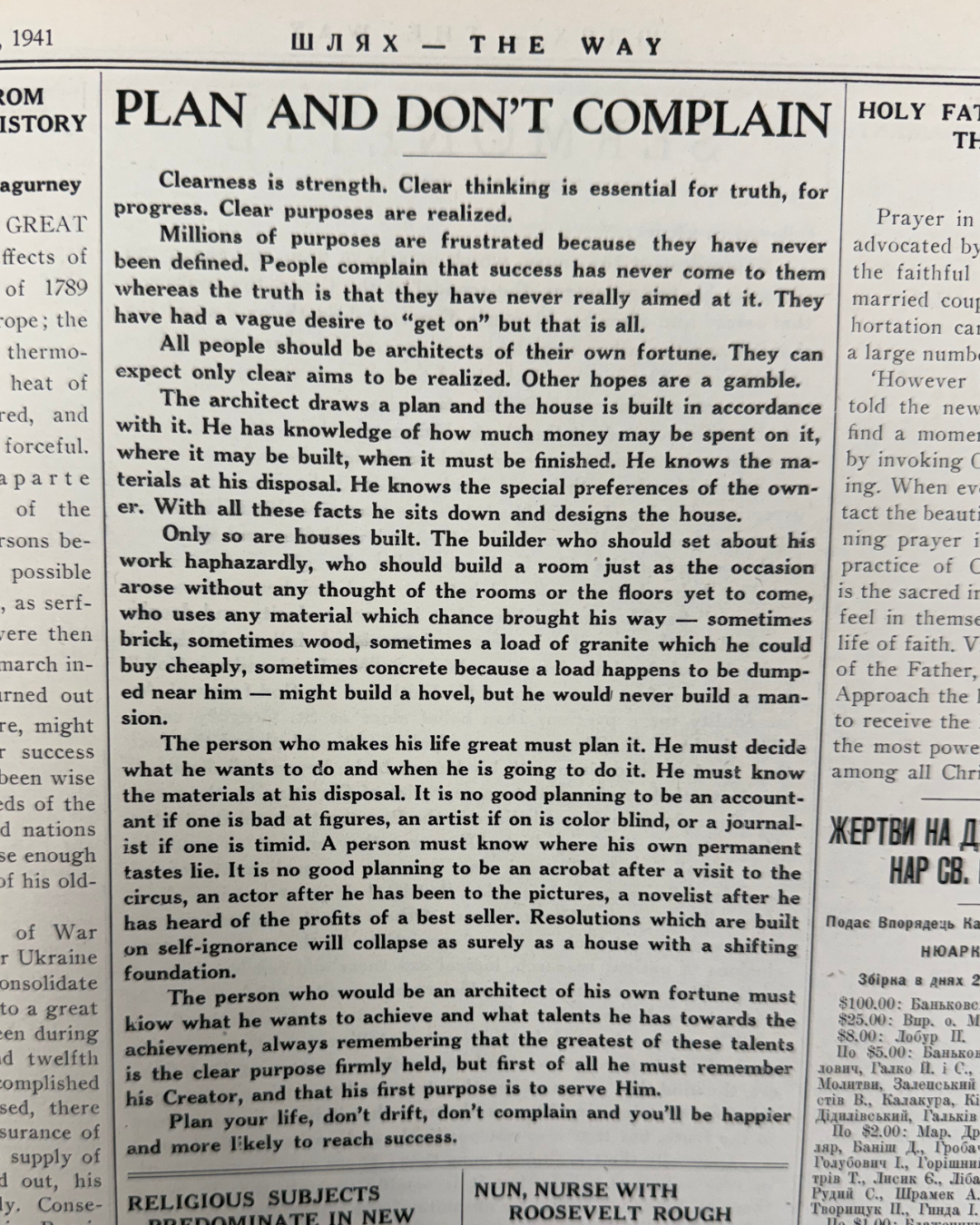
Clearness is strength. Clear thinking is essential for truth, for progress. Clear purposes are realized.
Millions of purposes are frustrated because they have never been defined. People complain that success has never come to them whereas the truth is that they have never really aimed at it. They have had a vague desire to “get on” but that is all.
All people should be architects of their own fortune. They can expect only clear aims to be realized. Other hopes are a gamble.
The architect draws a plan and the house is built in accordance with it. He has knowledge of how much money may be spent on it, where it may be built, when it must be finished. He knows the materials at his disposal. He knows the special preferences of the owner. With all these facts he sits down and designs the house.
Only so are houses built. The builder who should set about his work haphazardly, who should build a room just as the occasion arose without any thought of the rooms or the floors yet to come, who uses any material which chance brought his way — sometimes brick, sometimes wood, sometimes a load of granite which he could buy cheaply, sometimes concrete because a load happens to be dumped near him — might build a hovel, but he would never build a mansion.
The person who makes his life great must plan it. He must decide what he wants to do and when he is going to do it. He must know the materials at his disposal. It is no good planning to be an accountant if one is bad at figures, an artist if one is color blind, or a journalist if one is timid. A person must know where his own permanent tastes lie. It is no good planning to be an acrobat after a visit to the circus, an actor after he has been to the pictures, a novelist after he has heard of the profits of a best seller. Resolutions which are built on self-ignorance will collapse as surely as a house with a shifting foundation.
The person who would be an architect of his own fortune must know what he wants to achieve and what talents he has towards the achievement, always remembering that the greatest of these talents is the clear purpose firmly held, but first of all he must remember his Creator, and that his first purpose is to serve Him.
Plan your life, don't drift, don't complain and you'll be happier and more likely to reach success.